
Claude AI Predicts Kerala Assembly Election: The Numbers Are Brutal.
Published: April 2026 | Reading time: 10 minutes
Most election predictions are built on vibes.
A panellist on TV. A WhatsApp forward. A journalist quoting a “senior leader” who spoke on condition of anonymity.
I wanted something different. Something built on data, not noise.
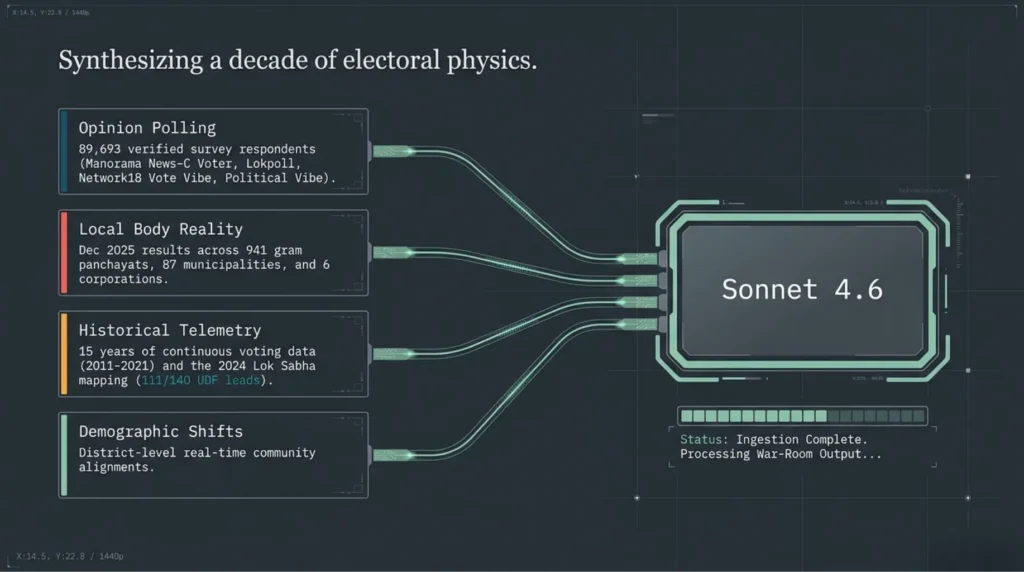
So I fed Kerala’s entire electoral picture into Claude Sonnet 4.6 — Anthropic’s frontier AI model,
and gave it one directive: no diplomacy, no hedging, no safe answers. Give me the prediction you’d stake your reputation on.
This is what it said.
Why AI? Why Now?
Before the prediction, understand the why — because it matters.
Simon Sinek says people don’t buy what you do, they buy why you do it. So here’s mine:
Kerala’s political commentary has a chronic problem. Everyone is too invested
party workers pretending to be analysts, journalists protecting sources, pollsters hedging ranges wide enough to drive a bus through.
AI has no constituency. It has no WhatsApp group. It doesn’t need to be invited back on the show next week.
Claude Sonnet 4.6 was given access to every major pre-poll survey (Manorama News–C Voter, Lokpoll, Network18 Vote Vibe, Political Vibe),
the December 2025 local body election results,
historical voting data from 2011–2021,
district-level demographic profiles, and real-time campaign developments.
Then it was asked to think like a war-room strategist whose reputation depends on getting it right.
Here’s what 89,693 survey respondents, one landmark local body election, and 15 years of Kerala electoral history look like when processed without ego.
The Prediction: Clean and Direct
| Alliance | Seats | Vote Share |
|---|---|---|
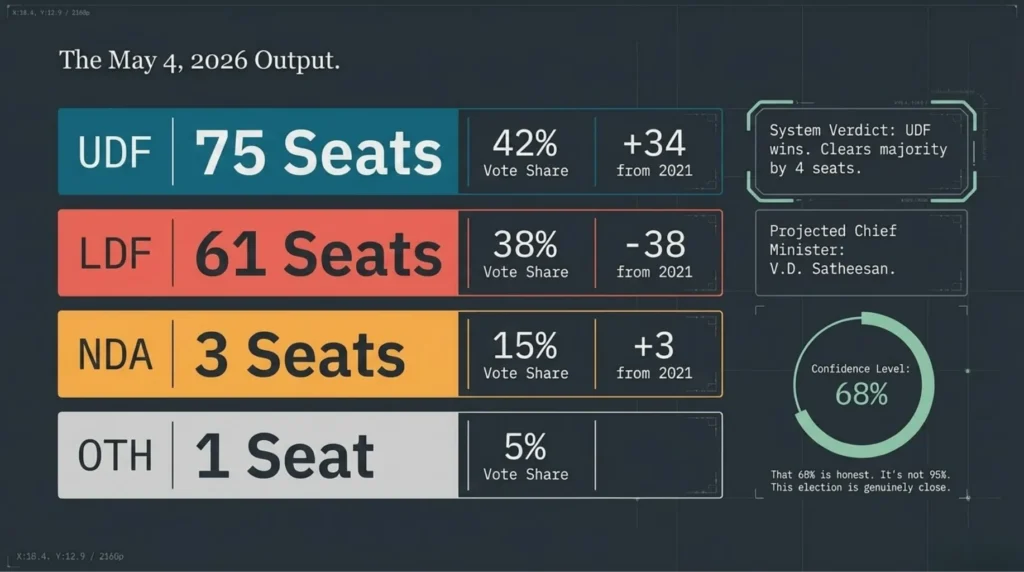
| UDF (Congress + IUML + KC-M + allies) | 75 | 42% |
| LDF (CPI-M + CPI + KC(J) + allies) | 61 | 38% |
| NDA (BJP + BDJS + allies) | 3 | 15% |
| Others | 1 | 5% |
Total seats: 140. Majority: 71.
UDF wins. Clears the majority by 4 seats. V.D. Satheesan becomes Chief Minister.
Confidence level: 68%.
That 68% is honest. It’s not 95%.
This election is genuinely close, and anyone telling you otherwise is selling you something.
The One Data Point That Changes Everything
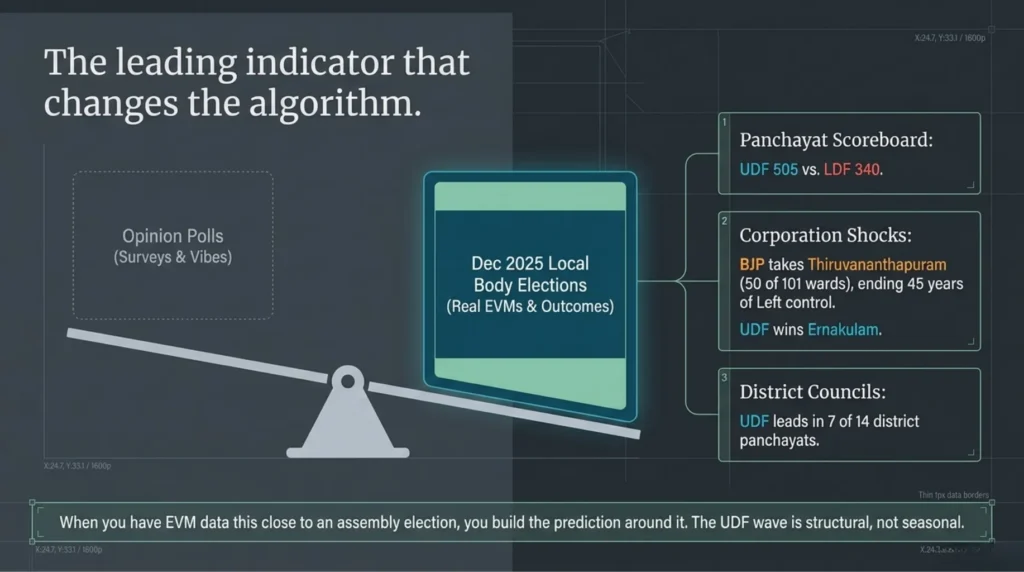
Opinion polls are surveys. Local body elections are results.
In December 2025, Kerala voted in local body elections across 941 gram panchayats, 87 municipalities, and 6 corporations. These are real EVMs. Real booths. Real outcomes.
UDF won 505 gram panchayats. LDF won 340.
BJP took Thiruvananthapuram Municipal Corporation — ending 45 years of continuous Left control — with 50 of 101 wards. LDF was pushed to 29.
UDF won Ernakulam Corporation. UDF led in 7 of 14 district panchayats.
When you have this quality of data this close to an assembly election, you don’t give it equal weight to an opinion survey. You build the entire prediction around it. And that data says one thing clearly: the UDF wave is structural, not seasonal.
Why LDF Is Losing
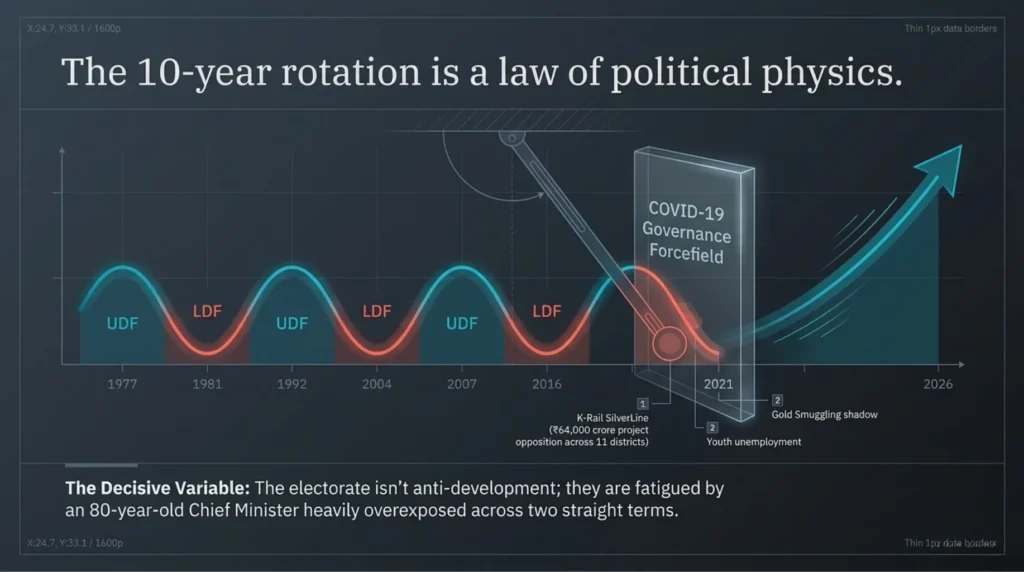
Start with the most important word in Kerala politics right now: decade.
The LDF has governed Kerala for approximately 10 consecutive years.
Kerala’s political DNA — high literacy, politically aware, deeply opinionated electorate
— has historically rotated governments every five years without exception.
The 2021 win was the first break from that pattern since 1977.
That was a one-election exception driven by COVID-era governance credibility. That credibility has been spent.
What’s replaced it:
The K-Rail (SilverLine) controversy — a ₹64,000 crore project that galvanised community opposition across 11 districts.
The gold smuggling case shadow that hasn’t left the CM’s office.
Youth unemployment that welfare schemes haven’t addressed.
And a Chief Minister who is 80 years old, visibly fatigued as a public narrative, and who voters have watched on their screens for two straight terms.
Here’s the honest political reality: there is no strong anti-incumbency against the LDF’s governance record.
Their development metrics are real. Their welfare delivery is real.
The dissatisfaction is directed more at Pinarayi Vijayan personally than at what the government built.
That distinction matters — but it doesn’t change the outcome. In democratic elections, “tired of seeing the same face” is as valid a vote as any other.
Why UDF Wins — But Without a Mandate to Celebrate
UDF isn’t winning because they deserve it. They’re winning because they’re not the LDF and they finally stopped tripping over themselves.
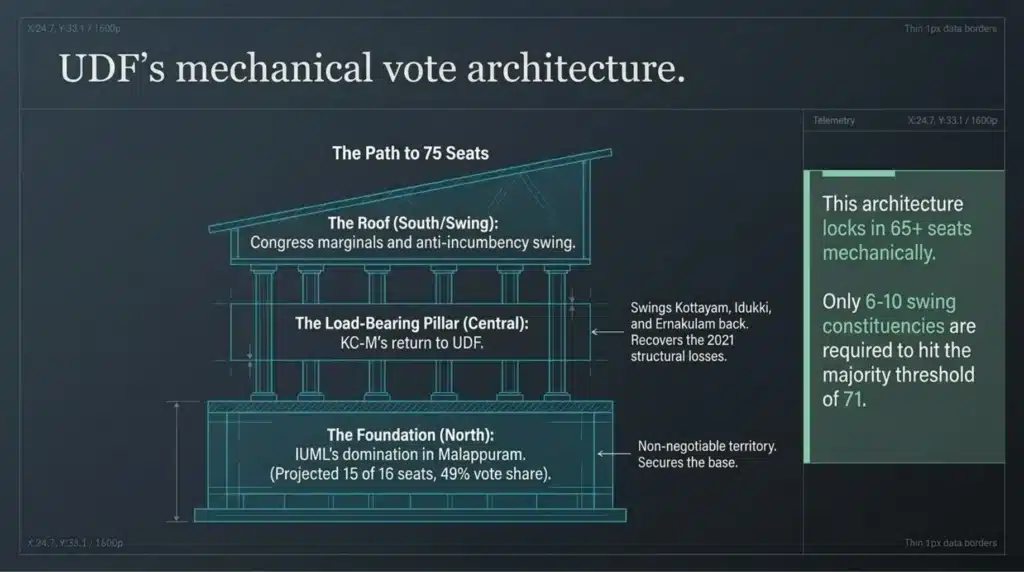
V.D. Satheesan ran a disciplined campaign. The internal Congress rebellion over seat-sharing cost them early narrative control, but they recovered. More importantly, the alliance architecture is strong: IUML owns Malappuram. KC-M’s return to UDF (after switching to LDF in 2021, costing UDF central Kerala heavily) swings Kottayam, Idukki, and Ernakulam back.
That’s 15–18 seats on alliance arithmetic alone — before a single vote is cast on anti-incumbency.
Add IUML’s near-total domination of Malappuram (projected 15 of 16 seats, 49% vote share), and UDF already has the architecture for 65+ seats before accounting for swing constituencies.
The 2024 Lok Sabha data reinforces this — UDF led in 111 of 140 Assembly segments in the parliamentary election. Assembly voting patterns differ. But 111 segments don’t forget how they felt 18 months earlier.
The District Breakdown
This is where the prediction lives or dies. Not in the headline number — in the 14 districts.
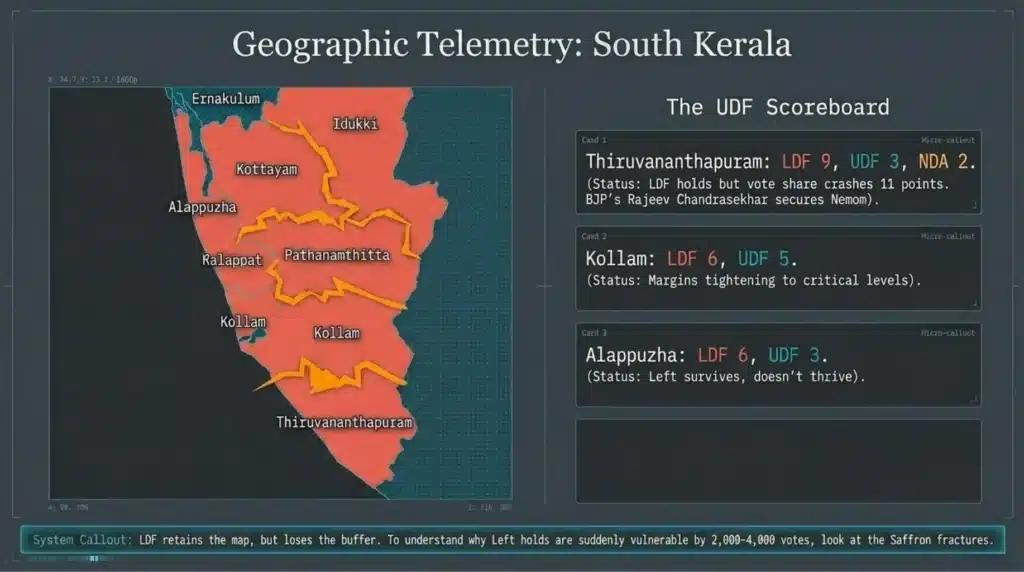
South Kerala — LDF survives, doesn’t thrive.
Thiruvananthapuram: LDF 9, UDF 3, NDA 2. LDF holds but bleeds. BJP’s Rajeev Chandrasekhar wins Nemom. V. Muraleedharan competes hard in Kazhakoottam. LDF’s vote share crashes 11 points from 2021.
Kollam: LDF 6, UDF 5. Alappuzha: LDF 6, UDF 3. Both stay Left but are closer than they’ve been in years.
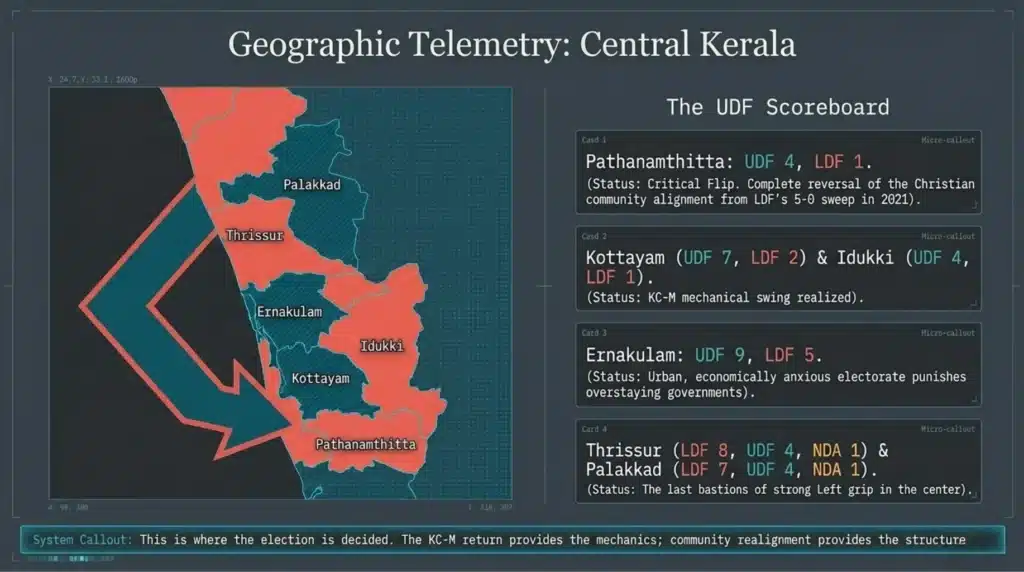
Central Kerala — Where the election is decided.
Pathanamthitta: UDF 4, LDF 1. LDF won all 5 seats in 2021. This single district flip represents the complete reversal of Christian community alignment.
Kottayam: UDF 7, LDF 2. Idukki: UDF 4, LDF 1. KC-M’s return to UDF is the mechanical explanation. The community alignment is the structural one.
Ernakulam: UDF 9, LDF 5. Kerala’s commercial capital goes UDF in a educated, economically anxious, urban electorate that consistently punishes overstaying governments.
Thrissur: LDF 8, UDF 4, NDA 1. Palakkad: LDF 7, UDF 4, NDA 1. The LDF holds its grip in these two districts.
North Kerala — UDF’s scoreboard.
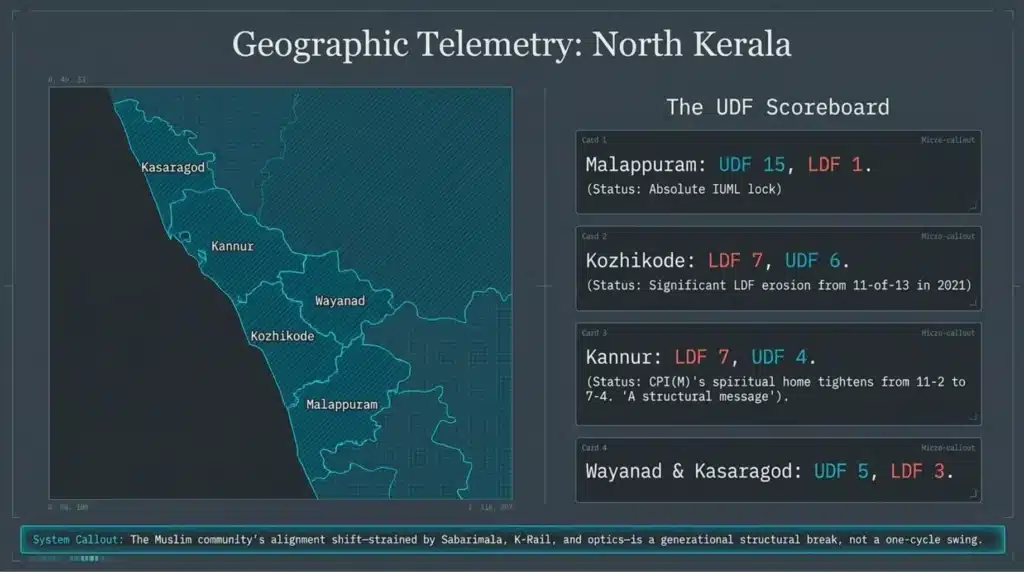
Malappuram: UDF 15, LDF 1. Non-negotiable IUML territory.
Kozhikode: LDF 7, UDF 6. Down from LDF 11-of-13 in 2021 — the erosion is significant even if LDF holds.
Kannur: LDF 7, UDF 4. The CPI(M)’s spiritual home tightens from an 11-2 dominance to 7-4. That’s not just electoral data — it’s a message.
Wayanad: UDF 2, LDF 1. Kasaragod: UDF 3, LDF 2.
The BJP Factor — Small Seat Count, Large Electoral Impact
BJP wins 2–3 seats. On its surface, that’s irrelevant.
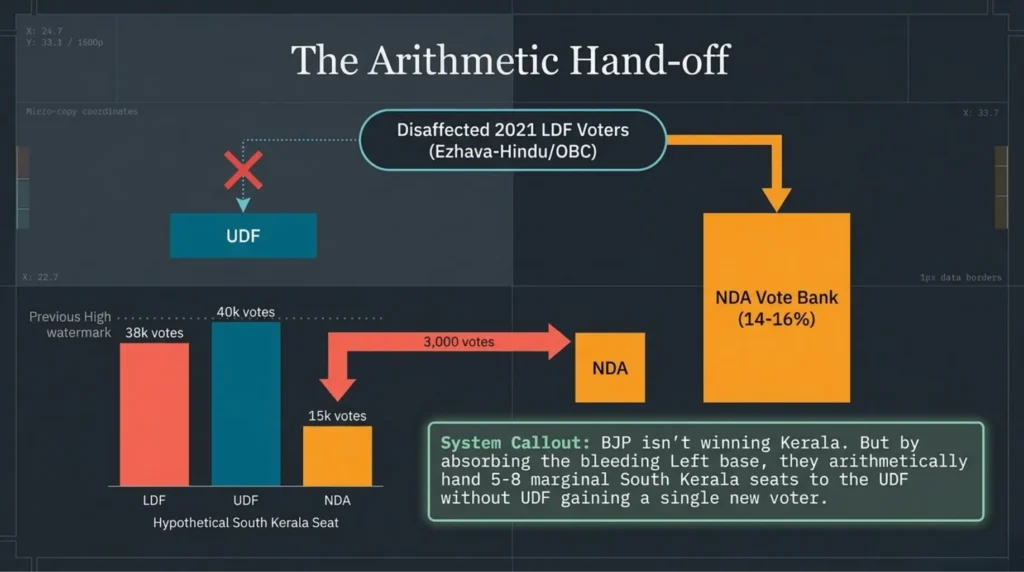
It isn’t. BJP is polling 14–16% of the vote.
That vote comes primarily from Ezhava-Hindu and OBC communities in south Kerala — communities that were previously the LDF’s base.
When they shift to the BJP instead of LDF, the seats don’t automatically go to UDF.
But LDF loses the margin it needs to hold constituencies it would otherwise win by 2,000–4,000 votes.
BJP isn’t winning Kerala in 2026. BJP is arithmetically handing 5–8 south Kerala marginals to UDF while building its own base for 2031.
That’s not an accident. That’s the actual game being played.
The 10 Seats That Decide the Majority
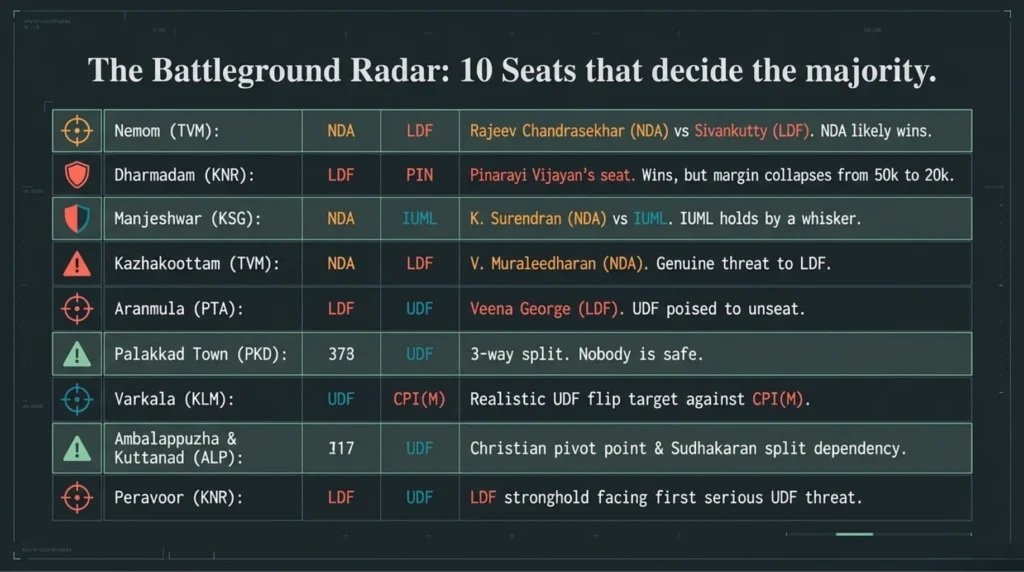
| Constituency | District | Why It Matters |
|---|---|---|
| Nemom | Thiruvananthapuram | BJP’s Rajeev Chandrasekhar vs LDF’s Sivankutty — NDA likely wins |
| Dharmadam | Kannur | Pinarayi Vijayan’s seat wins, but the margin collapses from 50,000+ to ~20,000 |
| Manjeshwar | Kasaragod | BJP’s K. Surendran vs IUML — IUML likely holds by a whisker |
| Kazhakoottam | Thiruvananthapuram | BJP’s V. Muraleedharan — genuine threat to LDF |
| Aranmula | Pathanamthitta | Health Min. Veena George — UDF poised to unseat |
| Palakkad town | Palakkad | Three-way LDF-UDF-NDA split — nobody is safe |
| Varkala | Kollam | Congress targeting this CPI(M) seat — realistic flip |
| Ambalappuzha | Alappuzha | G. Sudhakaran (Ind/UDF) vs CPM — depends on split |
| Kuttanad | Alappuzha | NCP-SP vs KC(J) — Christian community pivot point |
| Peravoor | Kannur | LDF stronghold facing first serious UDF threat |
Three Scenarios. One Honest Assessment.
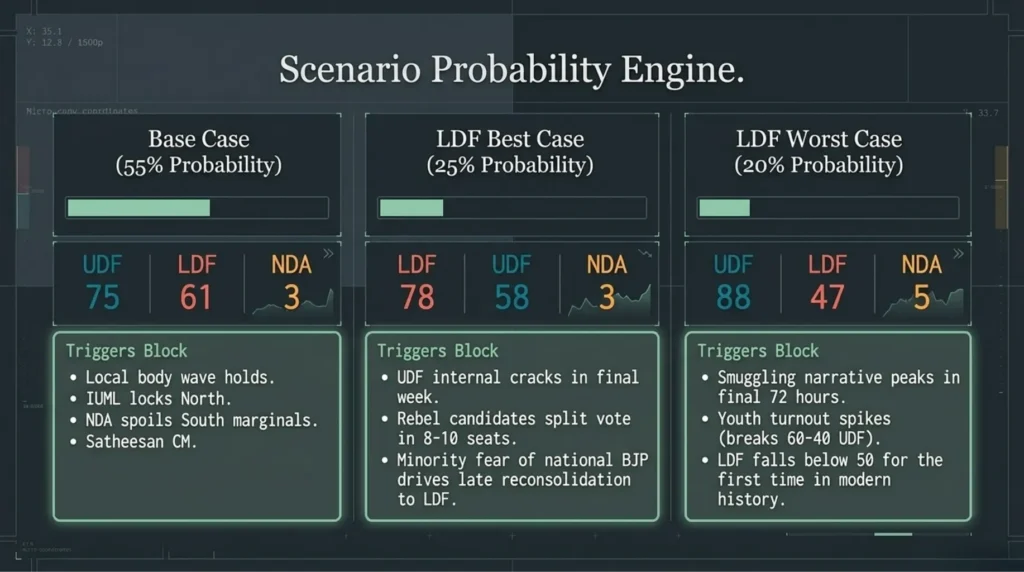
Base Case — 55% probability UDF 75. LDF 61. NDA 3. The local body wave translates to assembly seats.
+Anti-incumbency bites in central Kerala. IUML locks north. NDA spoils enough South Kerala seats to deliver UDF the marginals. Satheesan is CM.
Best Case for LDF — 25% probability LDF 78. UDF 58. NDA 3. UDF’s internal cracks widen in the final week.
Rebel candidates split the vote in 8–10 constituencies. Minority communities have a late consolidation back to the LDF driven by fear of the BJP’s national trajectory. Pinarayi’s personal vote bleeds into the surrounding Kannur-belt seats.
Worst Case for LDF — 20% probability UDF 88. LDF 47. NDA 5. Gold smuggling narrative reaches critical mass in the final 72 hours.
Youth turnout spikes and breaks 60-40 UDF. NDA doubles its south Kerala seat count. LDF falls below 50 for the first time in modern history.
The 5 Factors Deciding This Election
1. Anti-incumbency pressure of a decade in power. 10 years is longer than Kerala has ever let one alliance sit.
The rotation instinct is structural in this electorate. Impact: 8–12 seat swing to UDF across marginals.
2. The 2025 local body verdict. 505 vs 340 in gram panchayats. BJP is taking Thiruvananthapuram Corporation.
UDF winning Ernakulam. This is scoreboard data, not survey data. It is the single most reliable leading indicator available.
3. Minority vote architecture. IUML’s grip on Malappuram is absolute. KC-M’s return to UDF reshapes central Kerala.
If this block holds without defection or split, UDF has a structural majority before accounting for any anti-incumbency swing.
4. NDA as a vote-splitting mechanism. Their 15% vote share functions primarily as a structural disadvantage for LDF in south Kerala marginals — delivering 5–8 seats to UDF that would otherwise be close Left holds.
5. Pinarayi Vijayan’s personal polarisation. He is simultaneously LDF’s greatest organisational asset and their most significant emotional liability.
His presence mobilises the Left base in Kannur. His decade-long image energises the anti-LDF vote everywhere else.
What Happens After May 4
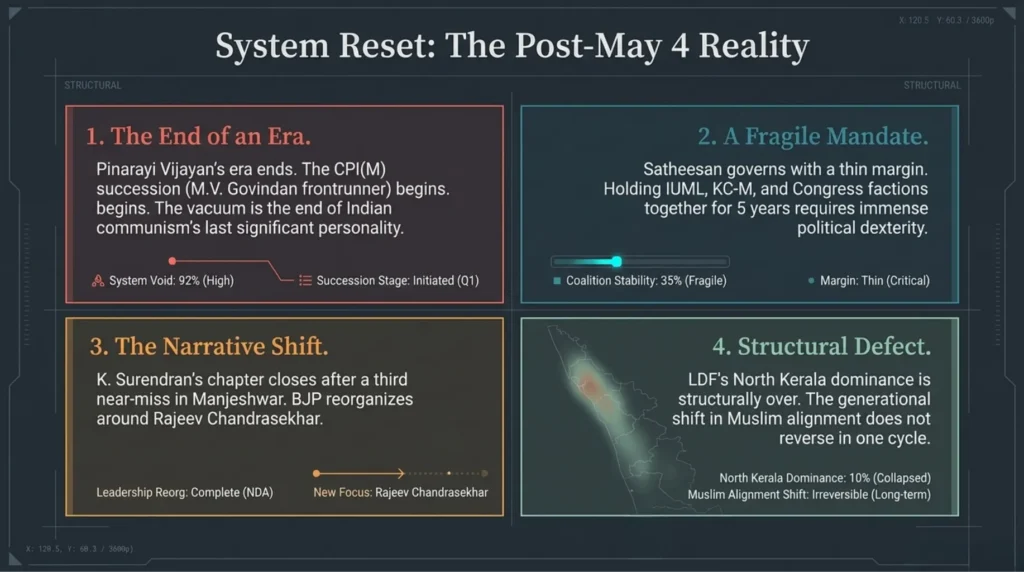
Pinarayi Vijayan’s era ends. Win or lose. At 80, this is the last campaign. The CPI(M) succession question — M.V. Govindan is the frontrunner — begins the moment results are declared. The vacuum he leaves is not just political. It is the end of Indian communism’s last significant personality.
K. Surendran’s chapter closes. Two near-misses in Manjeshwar. A third ends the narrative. BJP Kerala reorganises around Rajeev Chandrasekhar if Nemom goes as projected.
LDF’s north Kerala dominance is structurally over. The Muslim community’s alignment shift — strained by Sabarimala, K-Rail, and governance optics over 10 years — doesn’t reverse in one election cycle. This is a generational shift.
Satheesan governs with a thin margin. 75 seats is enough to form a government. It is not enough to dominate. Holding IUML, KC-M, and Congress factions together without a single major defection over 5 years requires more political dexterity than his current public profile suggests he possesses. The real test begins May 5.+
Why This Prediction Might Be Wrong
68% confidence means 32% probability of being completely wrong.
The 2021 election proved that Kerala can humiliate every pollster simultaneously. Every major survey is called UDF.
LDF won by 58 seats. The COVID effect, KC-M’s switch, and a last-mile wave nobody captured were the difference.
In 2026, the equivalent scenario requires: minority reconsolidation toward LDF in the final 72 hours, UDF internal splits in 8–10 key seats,
and a last-mile welfare narrative that overrides 10 years of governance fatigue.
It’s possible. That’s why it’s a 25% scenario, not a 0% scenario.
But the local body scoreboard makes it less likely an outcome. And that scoreboard wasn’t built on surveys.
The Bottom Line
Claude Sonnet 4.6’s prediction, synthesised across 89,693 survey respondents, 941 gram panchayat results, 40 years of electoral history, and district-level demographic data, is this:
UDF wins 75 seats. LDF wins 61. NDA wins 3.
V.D. Satheesan becomes Kerala’s Chief Minister after the results on May 4, 2026.
Kerala’s rotation pattern — broken once in 2021 — reasserts itself.
The Left governed well. They governed too long. And in a democracy with a fully literate, fully opinionated electorate, those two things are not mutually exclusive.
The voters of Kerala will have the final word on April 9.
This prediction was generated using Claude Sonnet 4.6 (Anthropic), synthesising pre-poll survey data, 2025 Kerala local body election results, district-level demographic analysis, and historical voting patterns. Data current to April 6, 2026. Results declared May 4, 2026. All predictions carry inherent uncertainty.