
Hiring a Digital Marketing Freelancer in Dubai: A Complete Guide
Let me guess. You know your business is good, your product or service is solid, your customers love you when they actually find you, but online you feel a bit like a shop hidden behind a construction site in Deira at midnight.
If that sounds familiar, you are exactly who I am writing this for.
I am talking to the SME owner in Al Quoz trying to compete with brands that have marketing teams bigger than your entire staff list. The founder in Business Bay who keeps hearing “you should run ads” but has no idea where to start. The CEO in JLT who is tired of paying retainers to agencies that send pretty reports but weak results. The marketing manager who is stuck between a demanding boss and an underperforming agency, secretly Googling “digital marketing freelancer in Dubai who actually knows what they’re doing”.
You are not crazy. Digital marketing in the UAE has become noisy, expensive, and confusing. And you are supposed to figure it out while running operations, managing people, watching cash flow, and still making it home before everyone sleeps.
This is where a serious digital marketing freelancer in Dubai becomes less of an option and more of a practical survival tool.

Why this conversation matters right now in Dubai
Every year, the digital landscape in Dubai and across the UAE gets more crowded. More brands enter the market. More content floods social media. More ads chase the same people. Platforms change rules, new tools appear, and someone is always shouting that whatever you are doing is already “dead”.
But one thing has stayed constant. Your customers are online. They scroll while sitting in traffic on SZR, while waiting for their karak, while sitting in the office pretending to be “in a meeting”. They search, compare, stalk brands quietly, and make decisions long before they speak to a salesperson.
If your brand is invisible, inconsistent, or confusing in those moments, you are not just “missing out on awareness”. You are giving business to the competitor who shows up more clearly and more often.
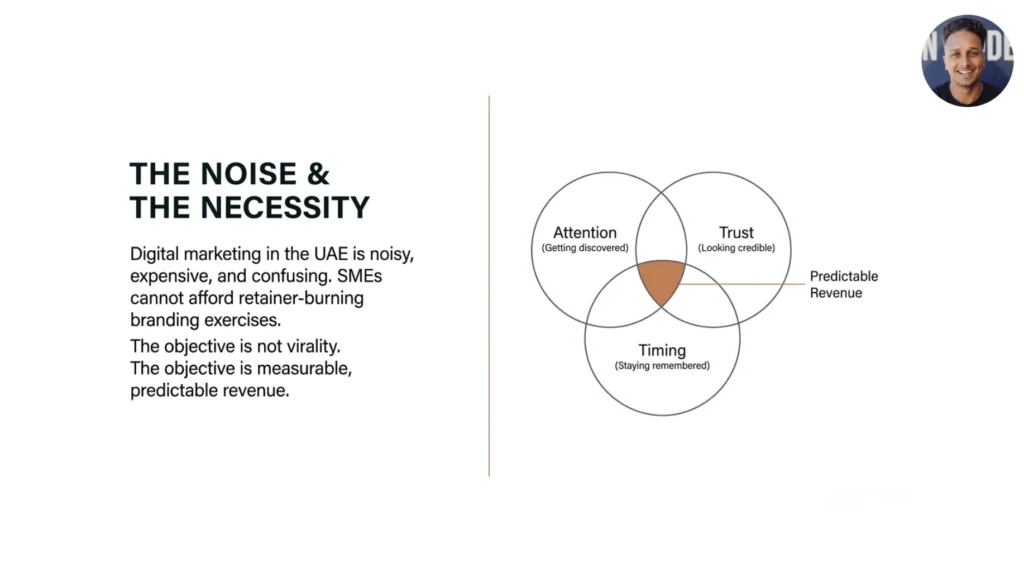
That is the real game you are in. Attention, trust, and timing. Not vanity metrics, not followers, not viral trends.
I talk about this quite brutally in my article “Marketing is Not Magic, It is Math, Psychology and Patience”. The short version is simple. If your marketing cannot be explained in clear numbers and clear behavior, it is not marketing. It is entertainment.
Table of Contents
Why SMEs and startups in Dubai cannot afford to ignore digital anymore
If you run a small or medium sized brand in Dubai, you do not have the luxury of waste. You cannot keep burning retainers on “branding exercises” that never show up as leads or sales. You need marketing that actually does something measurable.
Digital is not a nice bonus on top of “real business” anymore. Digital is where your first impression is formed, where your trust is tested, and where your leads start their journey.
For a typical SME or startup in the UAE, digital marketing is not about “being everywhere”. It is about using the right channels with discipline so that you can:
- Get discovered when someone searches for what you sell.
- Look credible when that person checks your website, Instagram, LinkedIn, or Google Business Profile.
- Stay remembered through remarketing, email, or content so they come back when they are actually ready to buy.
- Track what is working so you stop paying for what is not.
None of that requires a giant agency. It requires clarity, consistency, and someone who understands both strategy and execution.
Where a digital marketing freelancer fits into this picture
A lot of founders in Dubai come to me after trying the usual path. Hire an agency, sign a retainer, get monthly reports with colorful graphs, feel guilty for not understanding half of it, keep going because “maybe next month it will improve”.
On the other extreme, some hire a junior in house, expect them to handle content, SEO, ads, email, design, and maybe also clean the CRM on Thursdays. That person burns out, you get inconsistent marketing, and you assume “digital does not work for our industry”.
A serious digital marketing freelancer in Dubai sits in a different position.
They are not a bloated agency with layers of account managers, and they are not a single overworked employee stuck in your office. They are an independent expert you bring in with a clear mission. You pay for their brain and their hands, not their office rent and pantry bills.
In the next sections of this guide, I will break down who exactly a digital marketing freelancer is, what they do, how they compare with agencies, how to check if they are actually licensed in Dubai, what to pay them, and how not to get scammed by big promises and small delivery.
For now, I want you to see something very simple.
Your problem is not “I need more marketing”. Your problem is “I need the right marketing, with the right person, for the stage my business is in”.
The real need behind “I want to hire a freelancer”
When business owners message me with “I need a digital marketing freelancer”, they rarely want ads or content for the sake of it. When we strip away the jargon, what they actually want is usually one of these:
- “I want predictable leads.” Not random spikes. Predictable, trackable, repeatable.
- “I am tired of guessing.” They want a clear plan that does not change every time a new trend appears on Instagram.
- “I need someone who understands Dubai.” Not generic strategies copied from other countries that ignore local culture, languages, and regulations.
- “I want fewer moving parts.” One person who can coordinate, execute, and report, instead of four vendors blaming each other.
If you read that list and thought, “Yes, that is me”, then you are in the right conversation.
A good freelancer will not just “run your ads”. They will help you answer deeper questions like:
- Who exactly are we targeting in the UAE, and where are they spending their time online.
- What are we asking them to do at each step, and how do we measure if it worked.
- Which channels deserve your limited budget right now, and which ones can wait.
- What is the minimum system we need so that marketing is not chaos, but a process.
Why this guide exists ?
The internet is full of fluffy content about freelancing and digital marketing, most of it written to rank on search engines, not to help an actual business owner in Dubai make better decisions.
I want this guide to do the opposite. Direct, practical, a little uncomfortable at times, useful if you are serious. If you want more of my style before you commit to reading the whole thing, you can explore my broader thoughts on marketing and storytelling on my blog.
For now, keep this in mind. You do not need to become a digital marketer. You do not need to understand every tool and every algorithm. You just need to understand the landscape well enough to choose the right freelancer, ask the right questions, and avoid the expensive mistakes that so many SMEs in Dubai keep repeating.
Let us start by getting very clear on who a digital marketing freelancer actually is, and how they are different from agencies and in house hires.

Who exactly is a digital marketing freelancer in Dubai?
Let us keep this simple. A digital marketing freelancer in Dubai is an independent professional who uses online channels to help your business get attention, traffic, leads, and sales, and gets paid per project, per month, or per hour instead of a salary.
They are not your full time employee. They are not a big agency. They are usually one person, sometimes with a small support team in the background, who mixes strategy with execution and plugs directly into your business.
In practical terms, a serious freelancer in Dubai is the person you call when you want someone who can say, “Here is what we will do for your brand, here is how we will do it, here is how we will measure it”, then actually log in to the ad accounts and tools and make it happen.
What freelancers actually do all day
Digital marketing is a broad term, which is polite code for “this can become chaos very fast”. A focused freelancer will usually work across a clear set of services instead of trying to do everything for everyone.
In Dubai, that usually looks like this list.
- Performance and ads work, such as planning and managing campaigns on Google, Meta, TikTok, or LinkedIn, setting budgets, writing ad copy, and tracking conversions.
- SEO and content work, such as researching what people in the UAE are searching for, planning content, optimizing your website pages, and improving your Google visibility.
- Social media and content systems, such as creating a content calendar, guiding your team on what to shoot, writing captions, and managing posting and engagement.
- Website and funnel support, such as improving your landing pages, fixing obvious “conversion killers”, and coordinating with developers or designers.
- Email and automation, such as setting up basic lead nurturing, simple automations, and campaigns around offers, events, or product launches.
- Analytics and reporting, such as setting up tracking, creating simple dashboards, and telling you in plain language what is actually working.
Some freelancers in Dubai also specialize in personal branding, content strategy, or storytelling. If that side of marketing interests you, you can see how I approach content and brand narrative on my main site, where I combine strategy with writing and positioning.
The important point is this. A good freelancer does not just “do tasks”. They think in systems. They connect your ads to your landing pages to your WhatsApp replies to your CRM. They keep asking, “Where are we losing people, and how do we fix that first”.
Typical skill sets and experience levels
Not all freelancers are at the same level. That is where most SME owners in Dubai get burnt. On paper, everyone is a “digital marketing expert”. In real life, the gap is huge.
You will typically see three broad levels when you talk to freelancers.
1. The beginner task taker
This person usually knows the tools but not the business. They can:
- Post content on social media.
- Boost posts or run basic ads.
- Use templates for landing pages or emails.
They are cheap, eager, and often overwhelmed when you ask “Why are we doing this” or “What is the plan for the next [insert period]”. They are not bad people. They are just not who you trust with your full marketing budget.
2. The solid specialist
This is where things start getting useful. This freelancer usually has clear strengths such as:
- Paid ads with a focus on lead generation.
- SEO for specific niches.
- Social media and content strategy for certain industries.
They understand how leads move from click to enquiry, they can read data, and they can explain what is happening without hiding behind jargon. For most SMEs in Dubai, this level is often the sweet spot if you pick someone who actually understands the local market.
3. The strategist operator
This freelancer thinks, “marketing system”, not “Instagram calendar”. They bring:
- Experience across multiple channels.
- Ability to design a clear strategy for your specific business model.
- Strong communication and reporting habits.
- Comfort dealing with founders, CEOs, and managers who want numbers and clarity.
They may not personally design every graphic or code every page. They know how to bring the right specialists into the project when needed, keep everyone aligned, and keep you focused on the right decisions. This is usually the profile I personally work from when I take on brands in Dubai.
Freelancer vs agency in Dubai, what actually changes for you
You have probably heard the usual cliché. “Freelancers are flexible, agencies are structured.” Let us be more precise, especially for the Dubai market.
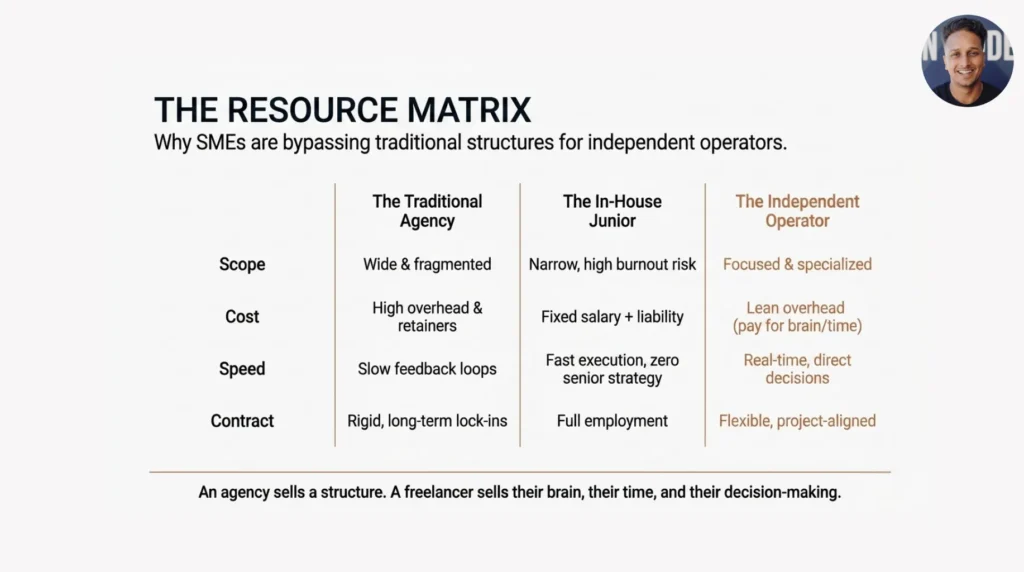
1. Service scope and depth
Agencies usually offer a wide menu of services. Branding, media buying, creative, web development, PR, and sometimes even offline production. That looks impressive, but it also means:
- Your account is split between different team members.
- You may get solid execution on one service and very average work on others.
- Small retainers often get junior teams, while senior experts are reserved for bigger accounts.
Freelancers usually offer a tighter scope. One or a few core services where they are actually good. For an SME in Dubai, that often works better because your main need is not “do everything”, your main need is “do the [insert top priority] properly and consistently”.
If you already have a designer in house, for example, you do not need an agency with a full creative department. You might just need a performance freelancer who can guide that designer on what to create for ads and landing pages.
2. Cost structures and overheads
Agencies in Dubai carry overheads. Office rent, management layers, sales teams, admin, all of that has to be paid. You feel this in:
- Minimum monthly retainers that are often above what early stage SMEs can justify.
- Extra fees for “strategy”, “creative direction”, or “campaign setup”.
- Contracts that lock you in for fixed periods to make the account financially viable for them.
A freelancer sits much leaner. You are mostly paying for their time, experience, and whatever small tools or support they use. That usually shows up in:
- More flexible retainers.
- Project based work when you want to test the relationship before committing long term.
- Clearer link between what you pay and what work is actually happening.
This is not about cheap versus expensive. It is about paying for what moves your business right now instead of funding an entire structure you do not really use.
3. Communication and decision speed
With a typical agency setup, you speak to an account manager, who then speaks to a strategist, who then speaks to an execution team, and by the time something changes, your offer has already expired.
With a freelancer, you usually talk to the person who is actually touching your campaigns. That gives you:
- Faster feedback loops when something is not working.
- Less “lost in translation” moments between you and the marketing plan.
- More honest conversations about what is realistic in your budget range.
For Dubai specifically, where markets move fast, seasons shift, and regulations can change how you run ads, speed of decision is not a luxury. It is survival.
4. Flexibility of contracts
Agencies tend to prefer longer term contracts with clear scopes. That protects them from constant churn and scope changes. There is nothing wrong with that, but if you are a small or medium brand still testing channels, it can feel like you are married before the first date.
Freelancers usually operate with more flexible setups.
- Shorter initial terms so both sides can see if the fit is right.
- The ability to ramp work up or down based on your season and cash flow.
- Custom scopes where you focus only on your highest priority channels.
This is especially useful if your business in Dubai has strong seasonality, for example, you are heavy on specific months, events, or tourism flows, and you want your marketing muscle to follow that rhythm instead of staying fixed all year.
How all this plays out in the Dubai context
Dubai is crowded with agencies and freelancers who promise the world. The difference is rarely in the Instagram feed. It is in how they work with you on the inside.
You want someone who can navigate:
- Multiple languages in your audience.
- Sensitivity around certain products or topics in your ads.
- Local platforms and habits, from messaging apps to location based searches.
- Regulations around advertising and licensing that are specific to the UAE.
Some agencies understand this deeply. Some freelancers do. Many do not. Your job is not to guess. Your job is to ask the right questions and look at the right signals, which we will get into in the later sections of this guide.
For now, keep this lens. An agency sells you a structure. A freelancer sells you their brain, their time, and their decision making. The question is not “which is better”. The question is “which one matches the stage, budget, and complexity of your brand in Dubai right now”.
Why Choose a Digital Marketing Freelancer in Dubai Over an Agency?
Let me start with the uncomfortable truth. Most SMEs in Dubai do not need an agency first. They need a sharp, experienced human who understands the local market, can think clearly, execute consistently, and does not vanish behind “we will check with the team”.
That is where a serious digital marketing freelancer makes a lot more sense than an agency for many brands in this city.
1. Direct communication, not Chinese whispers
With an agency, you usually talk to an account manager who talks to a strategist who talks to an ads specialist who talks to a designer. Somewhere in that chain, half your message dies and the other half gets misunderstood.
With a freelancer, you talk to the person who is actually touching your campaigns.
- You say “Our margins on this product are low, do not push heavy discounts.”
- They hear it once and adjust ad copy, audience targeting, and landing page messaging accordingly.
- No endless loops of “I will get back to you after checking internally”.
For a founder, CEO, or marketing manager in Dubai, this saves time and blood pressure. You can jump on a call, tweak strategy, change budgets, or shift focus, and the person on the other side can respond in real time, not in next month’s “strategic review”.
When you remove layers, you remove noise.
2. Tailored strategy for your actual stage, not for an agency deck
Agencies love frameworks, big retainers, and pretty slides. A lot of that is built for their own positioning more than your immediate needs.
A good freelancer works closer to your reality.
- If your brand is early stage, they focus on the fastest path to validated leads, not on ten channels at once.
- If you are already established, they refine funnels, clean tracking, and squeeze more performance out of what you already have.
- If your budget is tight, they cut non essentials and build a minimum viable marketing system instead of an “omnichannel ecosystem”.
Because they are not trying to “fill the agency resource calendar”, they can say uncomfortable but helpful things like:
- “You do not need TikTok right now, your buyers are making decisions elsewhere.”
- “Your landing page is killing conversions, fixing that is higher priority than increasing ad spend.”
- “Your offer is confusing, no campaign can fix that until we rewrite it.”
I talk about this kind of hard honesty in my more personal writing on how I think about marketing and business decisions. The short version is simple. Strategy is not about doing more, it is about doing less of the wrong thing.
3. Cost efficiency without pretending marketing is free
Let us be clear. A good freelancer is not “cheap”. If they are good, they value their time. The difference is how your money flows.
With a typical agency, your spend is split between:
- Office space, management salaries, admin, and sales costs.
- Layers of people who touch your account but never speak to you.
- Services you may not even use yet, bundled into a neat looking retainer.
With a freelancer, your money flows more directly to:
- Their time spent planning, testing, and optimizing your campaigns.
- Tools directly used on your account such as tracking, landing page builders, reporting dashboards.
- Occasional support specialists, for example a designer or developer, when the project genuinely needs them.
You are paying for brain and execution, not for an airbrushed office and espresso machine.
For SMEs in Dubai, this often means you can afford senior level thinking at a budget that would normally only get you a junior team inside a bigger agency. You still need to invest, but the ratio of “money in” to “real work out” tends to be much healthier.
4. Flexible contracts that match how business actually moves
Business in Dubai rarely moves in a straight line. You have peaks around certain months, events, tourism cycles, or industry specific seasons. Cash flow goes up and down. You test new offers, new verticals, new audiences.
Agency contracts are not always built for this kind of rhythm.
- You get locked into medium to long commitments while you are still trying to figure out if the relationship even works.
- Scope is tightly defined, any change sparks a “change request” conversation.
- Pausing or scaling down during slow months often becomes complicated.
Freelancers usually work with more flexible structures.
- Shorter initial agreements so both sides can test the fit.
- Project based engagements for specific goals, such as launch campaigns or funnel overhauls.
- Adjustable retainers where you can scale up or down based on seasons and priorities.
This does not mean everything is informal. A serious freelancer will still insist on a proper scope, terms, and boundaries. The difference is that those terms are usually written around what you actually need, not around what keeps a large team fully booked.
5. Legal compliance that protects you, not just them
Here is the part almost nobody reads carefully, then regrets later. In Dubai, digital marketing is not just “hire someone and send them your Instagram password”. There are licensing and advertising rules that matter for you, not just for the freelancer.
Freelancer licensing in Dubai
A serious digital marketing freelancer in Dubai should have:
- A valid license that allows them to offer marketing or advertising services as an independent professional inside the UAE.
- The ability to issue proper invoices under that license, for your accounting and tax records.
- Basic understanding of what they can and cannot advertise under UAE regulations, especially for sensitive categories.
When you ignore this and work with someone operating in a legal grey area, you are not just taking a “small risk”. You are:
- Making payments that may not be clean in your books.
- Opening yourself to trouble if an ad, claim, or campaign is questioned by a platform or authority.
- Relying on a partner who could disappear overnight if their setup collapses.
Agencies usually handle licensing on their side by default. With freelancers, you have to be more intentional. The good ones will happily share their license details and invoicing structure. If someone dodges basic questions about how they are licensed, treat that as a red flag.
Advertiser permits and platform compliance
Depending on what you promote, you may also need certain approvals or permits around advertising. A knowledgeable freelancer will guide you on:
- What kind of content may trigger platform review or rejection.
- What disclaimers or clarifications you should include for certain offers.
- How to align campaigns with both UAE norms and platform policies.
You do not need to become a legal expert. You just need a freelancer who takes compliance seriously instead of treating it as a small inconvenience. That is part of what you are paying for, especially if your industry is sensitive or regulated.
6. Ownership and transparency of your marketing assets
Here is another big difference that hits SMEs late. With some agencies, accounts and assets end up under the agency’s control. Ad accounts, pixels, analytics, even domains or landing pages sometimes sit under their master setup.
That feels convenient at the start and painful when you want to leave.
With a good freelancer, the default structure tends to look healthier for you.
- Your brand owns the ad accounts and analytics profiles.
- Your brand controls the website, landing pages, and key tools.
- The freelancer gets access and manages, but you retain ownership.
That way, if you later decide to bring work in house or move to an agency, you are not starting from zero. Your data, history, and assets stay with you. Your new partner plugs into what is already there instead of rebuilding everything “because we do it differently here”.
You want partners who build systems that survive the relationship.
So, freelancer or agency for Dubai SMEs?
If you run a small or medium sized brand in Dubai, here is a simple way to think about it.
- If you need multiple departments at once, heavy production, or massive media budgets, an agency can make sense.
- If you need sharp strategy, clean execution, clear communication, and flexible collaboration, a freelancer often fits better.
- If you are still testing offers, audiences, and channels, starting with a strong freelancer is usually the more rational move.
Neither path is automatically right or wrong. What matters is this. Do you have direct access to the person making decisions on your marketing, and are they both legally set up and practically aligned with how business works in Dubai.
In the next sections, I will walk you through what services freelancers in Dubai actually provide, how to judge who is competent, and how to avoid the classic traps that drain budget without moving revenue.
Key Digital Marketing Services Offered by Freelancers in Dubai
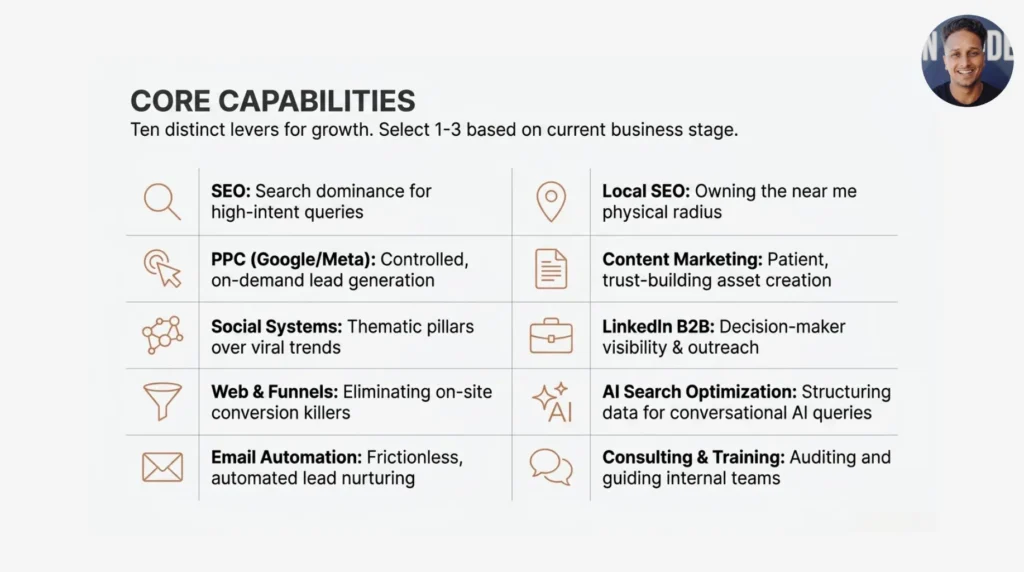
Let us talk about what a serious digital marketing freelancer in Dubai actually does for an SME, beyond “I will handle your socials, bro”. If you are a founder or manager, you do not care about fancy terminology. You care about, “What are we doing, where, and why”.
This section is your menu. Not a buffet where you eat everything, but a list of what is possible so you can decide what your business actually needs this year.
1. SEO, so people find you without paying for every click
SEO is about making your business show up when people in the UAE search for what you sell. Not for your brand name, for their problem. Things like “best [your service] in Dubai” or “[your product] near me”.
A good freelancer treats SEO as a long term asset, not a magic trick. Their work usually covers:
- Keyword mapping, what your ideal buyers are actually searching for in English, Arabic, or both.
- Technical clean up, making sure your site loads fast enough, works properly on mobile, and can be crawled by search engines.
- On page optimization, fixing titles, descriptions, headers, and content so Google understands what each page is about.
- Content planning, creating useful pages around questions your buyers keep asking, instead of random blog posts nobody reads.
If your business has mid to high ticket services, SEO is usually one of the smartest long term plays. Paid ads can be turned on or off. SEO quietly compounds in the background, if someone actually manages it with a plan.
2. PPC, Google Ads and Meta Ads, for controlled traffic on demand
PPC means you pay per click for traffic. The two main channels for most Dubai SMEs are:
- Google Ads for people who are actively searching with intent.
- Meta Ads for Facebook and Instagram, where people are scrolling, not searching.
A performance focused freelancer will usually handle:
- Account structure, setting up campaigns in a way that matches your services or product lines, not in a messy pile of random ads.
- Creative and copy, writing ad messages that actually sound like a human in Dubai, not a template from a random course.
- Audience strategy, deciding who should see what, from cold prospects to warm retargeting.
- Budget allocation, moving money towards what brings leads or sales, away from what just brings clicks.
- Conversion tracking, making sure that when a lead form is submitted, a purchase is made, or a WhatsApp chat starts, it is properly tracked.
If SEO is like buying a building, PPC is like renting a billboard with laser targeting. You can start fast, get data quickly, and shut it down if something is not working. The trick is to avoid turning it into a donation program for Meta and Google, which is where a good freelancer earns their fee.
3. Social Media Marketing that fits your business, not trends
Social media in Dubai can turn into theatre if you are not careful. Endless posts, no clear purpose. A freelancer who knows what they are doing will push you to define the job of each platform.
They will usually help with:
- Channel selection, deciding whether your business really needs Instagram, TikTok, Snapchat, LinkedIn, or just a focused mix of them.
- Content pillars, 3 to 5 themes that your brand will talk about repeatedly, so the audience understands who you are and what you stand for.
- Content calendar, planning posts around offers, seasons, and campaigns, instead of waking up every day asking “What do we post today”.
- Caption writing and hooks, creating posts that actually get people to stop, read, and take action.
- Basic engagement management, such as replying to comments, DMs, and filtering the real leads to your team.
For some brands, organic social will be a strong acquisition channel. For others, it will be more about credibility and nurture. A smart freelancer will help you decide which role it plays for you, instead of promising viral miracles.
4. Email Marketing and Automation, for follow up that never forgets
Leads in Dubai rarely convert on the first touch. They get busy, distracted, or they want to compare. If you do not follow up properly, you are not “respecting their space”. You are gifting them to someone else.
That is where email marketing and automation come in. A freelancer who understands this can help you build a simple but strong system.
- List building setup, capturing emails from website forms, lead magnets, or enquiry points into one place.
- Nurture sequences, automated email series that educate, answer objections, and keep your brand in mind.
- Broadcast campaigns, targeted emails around new offers, events, seasonal promotions, or content.
- Basic segmentation, grouping people by interest, stage, or product, so you do not send one generic message to everyone.
This does not need to become a complex marketing “machine”. Even a few well written automated emails can stabilize your conversion rate over time. You do the work once, and the system keeps working quietly.
5. Website Development, usually WordPress or Shopify
Your website is not a brochure, it is a salesperson that works without sleeping. If that salesperson is slow, confusing, or ugly on mobile, your ads are paying to send traffic to a dead end.
Many freelancers in Dubai offer website development, often with:
- WordPress for service businesses, B2B, and brands that need flexibility with content.
- Shopify for e commerce brands that want a clean, reliable store with payment integrations.
The good ones focus on function before aesthetics. They care about:
- Clear navigation and user flow, so a visitor knows where to click next.
- Sharp messaging above the fold, who you are, what you do, and why they should care.
- Strong calls to action, such as “Book a call”, “Get a quote”, “Order now”.
- Mobile performance, since a large part of your UAE audience will check you on their phone first.
Some freelancers design and build. Others work with a designer or developer. What matters for you is the end result, a site that helps marketing, not just decorates your business card.
6. Local SEO and Google Business Profile, for “near me” dominance
If your business has a physical location or serves a clear local area, local SEO and Google Business Profile optimization are non negotiable.
Here, a freelancer can help you:
- Set up and verify your Google Business Profile correctly.
- Optimize your profile with relevant categories, descriptions, images, and service areas.
- Structure local landing pages for different locations you serve.
- Plan a system for getting regular, high quality reviews from real customers.
This is one of the fastest ways to catch people searching things like “[your service] near me” around Dubai. You would be surprised how many SMEs ignore this, then complain that leads are only going to better organized competitors.
7. Content Marketing, the patient asset builder
Content marketing is where you stop begging for attention and start earning it. Blogs, articles, videos, and long form content that answer real questions your buyers have.
A content oriented freelancer can help you with:
- Content strategy, defining themes and topics that align with your offers and target segments.
- Editorial calendar, planning a realistic publishing rhythm you can actually sustain.
- Writing or scripting, turning your expertise into content that is clear, honest, and readable.
- SEO alignment, choosing topics that not only help people, but also support your search visibility.
- Repurposing, turning one strong piece into multiple formats across social, email, and website.
If you want to understand how I personally think about content as a system, you can explore my content marketing hub, where I break down content as a growth asset, not just a posting habit.
For many B2B and high trust industries in Dubai, content is the reason a lead chooses you instead of the cheaper competitor. It shows how you think, not just what you sell.
8. LinkedIn Marketing, especially for B2B and premium services
For B2B brands, consultants, agencies, and premium service providers, LinkedIn is less about vanity likes and more about being visible to decision makers.
A freelancer who lives on LinkedIn can help you with:
- Profile positioning for founders or key leaders, so you look like someone worth listening to, not just “Managing Director at [company]”.
- Content framework, consistent posts that share insights, behind the scenes, and direct offers without sounding desperate.
- Network building, connecting strategically with people in your target industry or region.
- Basic outreach, structured, respectful messages that start conversations, not spam storms.
- LinkedIn Ads, if your ticket size justifies paying for highly targeted decision maker visibility.
For some SMEs, LinkedIn alone can become the main driver of high value leads. For others, it plays a supportive role to website and email. Again, the right freelancer helps you decide how heavy your focus should be here.
9. AI Search Optimization, getting ready for how people actually ask
Search is shifting. More people are using AI assistants and conversational queries, not only traditional keyword searches. If you ignore this, your content can become invisible to a growing slice of your audience.
AI Search Optimization is about structuring your content and site so AI tools can understand, summarize, and reference you accurately.
A freelancer with AI driven marketing skills might support you with:
- Structuring content around clear questions and answers, not just long opinion pieces.
- Organizing your site so information is grouped logically by topic and intent.
- Using schema and structured data where relevant, so machines can interpret your content more easily.
- Planning content that addresses detailed, conversational queries, the type people ask AI tools and voice assistants.
This is not about chasing the latest shiny tool. This is about asking, “If someone asked an AI assistant about services like ours in Dubai, would that assistant even know we exist”. If you are curious about how I think about AI in marketing more broadly, my AI in marketing section goes deeper into systems and workflows.
10. Digital Marketing Consultation and Training, so your team stops guessing
Sometimes you do not need another person executing. You already have a junior marketer, a sales team, or a content person. What you lack is clear direction, a plan, and someone to review what is happening with a sharp eye.
That is where consultation and training come in. A senior freelancer can:
- Audit your current digital presence and campaigns.
- Help you prioritize which channels to focus on in the next [insert period].
- Set up dashboards so you stop arguing about metrics you cannot even see properly.
- Run workshops with your internal team on topics such as offer design, funnels, or content frameworks.
- Review ongoing work monthly, so your team improves instead of repeating the same mistakes.
This model works well for SMEs that want to keep execution in house over time, but still want senior level brains to shape the direction. You pay for judgment, not just for “someone to handle our Instagram”.
How to choose which services you actually need first
Looking at this list, it is easy to feel overwhelmed. That feeling is normal. The answer is not to do everything. The answer is to match services to your current situation.
A simple way to think about it:
- If nobody can find you when they search for your service, start with SEO and Local SEO.
- If you need leads fast and have a clear offer, start with PPC and landing pages.
- If your brand sells trust and expertise, add content marketing and LinkedIn.
- If you already get leads but conversion is weak, fix your website, follow up, and email systems.
A good freelancer in Dubai will not try to sell you the full menu on day one. They will pick the one or two highest leverage services for your stage, execute them properly, and build from there.
The goal is not to be everywhere. The goal is to be in the right places, with the right message, at the right depth.
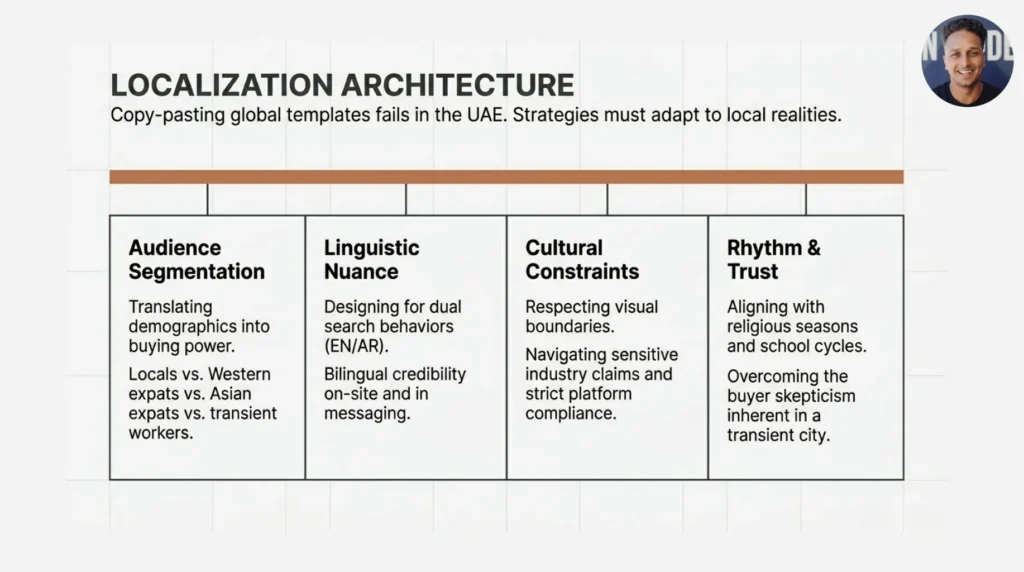
Understanding Dubai’s Unique Market & Cultural Landscape
If you try to copy paste a marketing strategy from another country into Dubai, it usually dies faster than an ice cream on JBR in August.
On paper, the tools look the same. Google, Meta, LinkedIn, email, websites, funnels. In reality, the way people in the UAE search, scroll, decide, and buy is shaped by culture, language, income levels, regulations, and a very particular kind of “Dubai speed”.
This is where a digital marketing freelancer who actually understands this city becomes dangerous in a good way. They are not just choosing platforms. They are translating your offer into something that works for this market, with its mix of expats, locals, regulations, and unspoken rules.
The people you are selling to are not one audience
If you are marketing in Dubai, you are not talking to “the UAE market”. That phrase is lazy. You are talking to overlapping segments with different expectations.
- Local Arabic speaking customers, with their own media habits and cultural lines you do not cross casually.
- English speaking expats from different regions, each bringing their own buying behavior.
- Workers on tighter incomes who think in instalments and offers.
- High income residents who care more about trust, privacy, and social proof than about small discounts.
- Business buyers who need approvals and paperwork, not just a nice landing page.
A freelancer who understands this will never build “one” funnel or “one” message for everyone in the UAE. They will push you to answer questions like:
- Which [insert top 1 to 3 segments] really matter for your growth this year.
- What language they actually use when they search and message you.
- Where they spend time online during the week versus during weekends.
- Who else influences their decision, for example spouse, boss, or friend group.
Once you know that, your campaigns start speaking to real humans, not to a demographic line in a report.
Language: English is default, but not always enough
Many SMEs in Dubai write everything in English and assume that is “global” and done. That is better than nothing, but it can quietly cap your growth.
A locally tuned freelancer will think about language on three levels.
- Search behavior, do your key phrases exist mostly in English, Arabic, or both. How are people actually typing or speaking them.
- Ad messaging, does it make sense to run English only ads, or to test Arabic for certain segments where trust and familiarity rise sharply in native language.
- On site experience, is your website or landing page usable and credible for both Arabic and English speakers, or are you silently telling one group “you are an afterthought”.
This does not mean you must build a huge bilingual empire on day one. It means your freelancer helps you pick your battles.
- They might start with English first, then add Arabic campaigns for [insert key service] that shows strong interest from Arabic queries.
- They might create a simple bilingual landing section for a high value offer instead of translating your entire site.
- They might test Arabic content on Meta while keeping English dominant on LinkedIn.
The goal is not perfection. The goal is respecting how people actually communicate in this city, so they do not bounce the moment your brand feels “not for me”.
Cultural nuance: what you say, show, and do not do
Dubai is open, but not careless. There are clear lines around religion, family, lifestyle, and certain topics that are better treated with respect and understatement. Many foreign templates ignore this. That is where trouble starts.
A freelancer who lives and breathes this environment will naturally filter your ideas through a local lens.
- They will advise on visual choices, for example how you represent people, clothing, lifestyle, and gender interaction in ads.
- They will avoid copy angles that might feel aggressive, disrespectful, or insensitive to local norms.
- They will watch tone around topics related to money, health, relationships, and religion.
This is not about walking on eggshells. It is about professional respect. You want marketing that feels sharp, honest, and confident without looking like it was copy pasted from a context that does not understand this region.
I talk a lot about narrative and perception in my political branding writing on how messaging shapes belief. Business is less dramatic than politics, but the principle is the same. If your message ignores people’s values, it does not just fail. It backfires.
Industry context: not every sector can advertise the same way
In Dubai, some industries can promote aggressively. Others must walk a narrower line. A freelancer who understands industry nuance will design your strategy around what is possible, not around what a random “7 figure funnel” webinar promised you.
They will consider constraints such as:
- How tightly your sector is watched by local authorities or platforms.
- What kind of claims you can safely make without heading into vague, exaggerated territory.
- Whether your offers require terms, conditions, or disclaimers to keep you safe.
- How long your typical sales cycle is, and how that affects which channels you should rely on.
For example, if your industry involves approvals, legal checks, or extended documentation, a freelancer will not sell you a “one click and they buy” dream. They will build a system that respects the longer path from first contact to signed deal, and they will track the right milestones along that path.
Regulation and platform rules: marketing that does not get you in trouble
Two things govern your campaigns in the UAE. Local regulations and individual platform policies. Ignore either of them and your ads can get rejected, your account can be blocked, or your brand can end up in a conversation you do not want.
A freelancer with real Dubai experience will usually build compliance into their process.
- They clarify with you what permits, approvals, or documentation you already have in place.
- They design messaging that is strong but still sits comfortably inside platform and local norms.
- They keep an eye on campaign rejections and appeals, instead of leaving your ads on “learning limited” purgatory.
Instead of pushing “edgy” content for clicks, they work with a simple principle. Visibility is only useful if it is sustainable. You are not trying to shock people for a week. You are trying to operate safely for years.
Timing, seasonality, and how Dubai’s calendar really works
Dubai eats linear plans for breakfast. There are religious seasons, school cycles, tourism waves, government announcements, sales festivals, and climate realities that shape when people spend and what they care about.
A locally tuned freelancer will not build your campaign calendar like a flat line. They will ask:
- Which months your industry typically peaks or slows.
- How religious holidays or long breaks affect your response rates.
- When big citywide events might drown your ads or, sometimes, boost them.
- How to time your offers so they do not clash with periods when your audience is mentally or physically elsewhere.
For example, for certain sectors it makes more sense to invest heavily in brand and content during quieter months, then push performance and acquisition during the natural demand waves. A good freelancer will help you shift budgets and creative focus, not treat every month as if it were identical.
Buyer psychology in a trust sensitive, transient city
There is an unspoken reality in Dubai. People come and go. Companies open and close. Scams exist. Over promises are common. Your potential buyers have learned to be suspicious, sometimes politely.
That means your digital marketing has to do a bit more work on trust.
Freelancers who get this will push you to improve things like:
- Clarity of offers, so what you sell sounds real, not exaggerated.
- Proof of work, such as certifications, portfolio elements, or social proof that comply with your legal comfort zone.
- Transparency on pricing structure, even if you do not publish exact numbers.
- Consistency of brand tone and visuals across website, socials, and ads.
They understand that in Dubai, many people have been burned before. That affects how they read your copy and how many touches they need before they commit. Good marketing in this context feels less like a “pitch” and more like a clear, grounded conversation.
How a freelancer connects all these pieces into a strategy for you
All of this can sound complex until you see what a competent freelancer actually does with it for an SME.
In practice, they will help you:
- Define your primary segments in the UAE, not by age and gender only, but by language, motivation, and buying power.
- Pick priority languages and channels for those segments, instead of spraying content everywhere.
- Shape your message so it respects local culture while still sounding like you, not like a generic brand.
- Align offers and campaigns with the local calendar, using peak periods intentionally instead of reacting at the last minute.
- Stay legally and ethically safe, with campaigns that pass platform checks and keep your reputation clean.
This is why hiring “a marketer who knows tools” is not enough in Dubai. You want someone who can read the city as well as they read a dashboard.
If you want to see how I personally think about strategy and storytelling across cultures, my story driven content work is built on the same idea. People do not respond to tactics. They respond to messages that respect who they are, where they live, and what they value.
The right freelancer in Dubai does not just run campaigns. They translate your brand into the language of this market, across culture, regulation, and behavior.
How to Find and Evaluate the Right Digital Marketing Freelancer in Dubai
Let us be honest. “Finding a freelancer” in Dubai is not the problem. You can post one vague line on social media and your inbox will fill with “Dear Sir, I will grow your business 10x”.
Your real problem is choosing the right one without losing money, time, or your patience.
This section will keep you out of trouble. We will cover where to look, how to scan portfolios like a pro, how to check licensing, and how to run interviews that reveal who actually knows what they are doing.
Where to find digital marketing freelancers in Dubai
You do not need to search everywhere. You need to search in the right places with the right filters.
1. Freelance and talent platforms
There are global and regional platforms where Dubai based freelancers list their services. Use them, but do not treat them like online shopping.
When you use any platform, filter and screen like this:
- Location filter, set to UAE or Dubai, so you are not flooded with people who have never dealt with UAE regulations or culture.
- Service specificity, search for clear skills such as “Google Ads for lead generation” or “SEO for service businesses” instead of “digital marketing” alone.
- Project relevance, look for profiles that talk about work similar to what you need, for example e commerce, B2B services, clinics, education, real estate.
Treat platforms as a starting point. The serious filtering happens in your conversation, not on their profile page.
2. LinkedIn and your existing network
For Dubai, LinkedIn is one of your best hunting grounds for serious freelancers, especially those who work with founders and B2B brands.
Use LinkedIn search with a focused approach:
- Search job titles such as “Freelance digital marketer”, “Performance marketer”, “SEO consultant”, “Paid media specialist”.
- Filter by location to United Arab Emirates, then narrow down informally to people who clearly operate in Dubai.
- Look at what they actually post. Do they share practical insights, or only self promotion and vague motivational lines.
Then use your network.
- Ask other founders or marketing managers in Dubai who they have actually worked with.
- Ask your internal team if anyone has seen or followed a freelancer who talks sense about marketing in this region.
Referrals are not a guarantee, but they are a better filter than random cold outreach. I see this often with people who find me through my about page, they have usually heard my name from someone who already follows my work.
3. Local events and communities
If you have the patience, local meetups, marketing events, and business communities can be good for spotting talent.
What you are looking for in person is simple:
- Who can explain what they do in plain language without bragging.
- Who asks good questions about your business instead of pitching immediately.
- Who sounds grounded about timeframes and results, not magical.
You are not trying to sign a contract at an event. You are trying to build a shortlist of people worth talking to later, calmly.
How to evaluate portfolios without getting hypnotized by pretty graphics
Most SME owners get overwhelmed by portfolios. Lots of logos, screenshots of dashboards, and “creative” posts that say very little about real performance.
Your goal is not to be impressed. Your goal is to understand how this person thinks.
1. Look for relevance, not just volume
Ask yourself:
- Have they clearly worked with businesses of a similar size, not only huge brands with giant budgets.
- Have they handled similar business models, for example lead generation for services, e commerce, or local brick and mortar.
- Do they talk in their portfolio about problems solved, or only “we reached [insert vanity metric] impressions”.
If their entire portfolio is fashion brands and you run a B2B logistics company, I would be cautious, unless they can clearly explain how they transfer their skills into your space.
2. Pay attention to how they describe their work
When a freelancer walks you through a project, listen for structure.
They should be able to explain, in simple sequence:
- The context, who the client was serving and what the main problem was.
- The diagnosis, what they discovered was actually broken or missing.
- The plan, what they decided to do first and why.
- The execution, which channels and tactics they used.
- The outcome in plain language, for example “they started getting more qualified leads per week, and cost per enquiry went down compared to before”.
If they cannot explain it like this, there is a decent chance they were not really the person in charge, or they are repeating buzzwords without real understanding.
3. Ask for specific role clarity
In agency or team projects, freelancers sometimes show work where they were only involved in a small slice.
Ask clear questions:
- “In this project, what exactly were you responsible for.”
- “Who handled the strategy, and who handled the daily execution.”
- “If something went wrong, who made the final decisions on what to change.”
You are not interrogating them for fun. You are checking whether they have the level of ownership and decision making you want for your own business.
Skills checklist that actually matters for Dubai SMEs
Forget long lists of tools. If someone says “I know [insert 20 platforms]”, that tells you nothing about depth.
For a small or medium sized business in Dubai, look for four core skill areas.
1. Strategic thinking
They should be able to:
- Map your customer journey from first contact to sale.
- Choose 1 to 3 priority channels for your stage instead of listing everything.
- Explain why something is a waste of your budget right now, even if it is trendy.
2. Channel depth
Depending on your main need, look for real depth in at least one of these:
- PPC and performance ads.
- SEO and content.
- Social and content systems.
- Conversion focused websites and funnels.
Depth means they can speak comfortably about targeting, offers, messaging, testing, and optimization, not just “we run ads and post content”.
3. Numbers and reporting
If a freelancer gets allergic to numbers, walk away.
They should be able to:
- Define the main metrics that matter for your business model, such as cost per lead, lead to sale rate, average order value.
- Set up basic tracking so those numbers are visible and reliable.
- Review performance with you regularly in a way you can actually understand.
4. Local understanding
This one is non negotiable if you are targeting people in the UAE.
- They should understand basic advertising boundaries in the region.
- They should show sensitivity to language and cultural context in copy and creatives.
- They should be familiar with common local industries, from real estate and education to clinics, retail, and services.
If you want a deeper sense of how I think about strategy and local nuance, you can explore my writing on narrative and influence inside my political marketing section. Different domain, same human psychology.
How to verify licensing and legal setup
This is the boring part that saves you painful emails later.
1. Ask directly about their license
A serious freelancer in Dubai will not be offended if you ask, they will actually expect it.
Questions to ask:
- “Under which license are you operating in the UAE.”
- “Does your license cover digital marketing and advertising services.”
- “Can you issue invoices with your license details for our accounting team.”
You do not need to become a licensing expert. You just need to see that there is a legitimate structure, not a story that keeps changing every time you ask for paperwork.
2. Check basic documentation
Before you send money, especially for retainers or larger projects, ask for:
- A copy of their trade license or permit, with activity that matches what they are offering you.
- Standard invoicing format they use, so your finance team knows how to process it.
- A basic contract template that outlines scope, payment terms, and responsibilities.
If they refuse all documentation and want to operate purely on informal messages and cash, treat that as a major warning sign. You are not hiring a friend to design a birthday invite. You are hiring someone who will handle your advertising and sometimes your data.
How to run interviews that reveal the truth fast
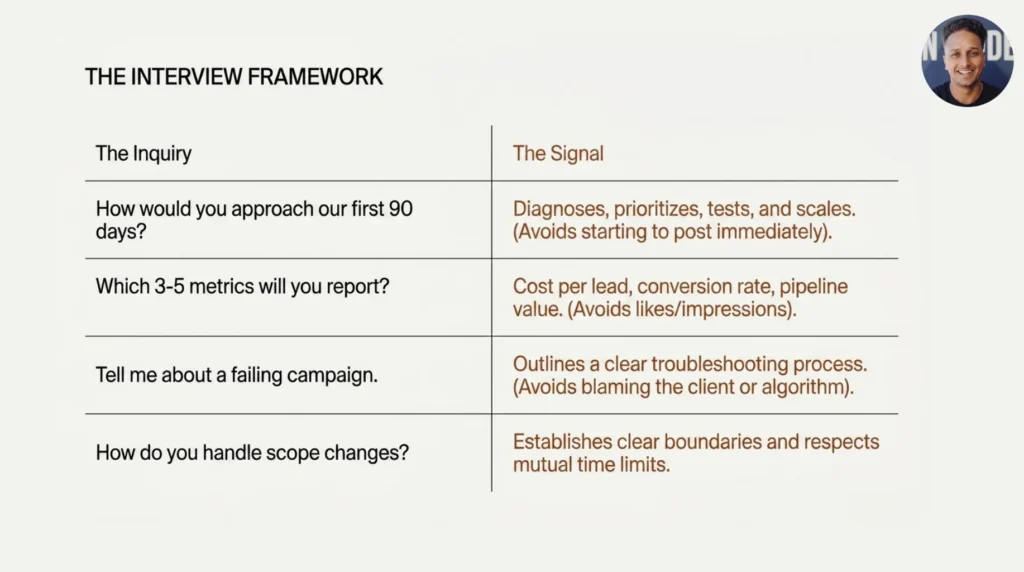
Think of the interview as a working session, not a polite chat. Your job is to see how this person thinks in real time.
1. Start with your context, not with “tell me about yourself”
Brief them on your business in a clear, structured way.
- What you sell and to whom.
- What you have already tried in marketing.
- What is not working that made you start this search.
- Your rough budget range for the next [insert period].
Then watch their first reaction.
- If they start pitching immediately, worry.
- If they start asking clarifying questions, pay attention.
2. Ask them to think through a simple scenario
Give them a realistic situation, for example:
- “We have [insert approximate budget] per month and our main goal is more qualified enquiries for [service]. How would you approach the first [insert period].”
You are not looking for a perfect plan. You are looking for signs of clear thinking.
- Do they start by clarifying the customer and offer.
- Do they focus on a few channels instead of listing everything.
- Do they mention testing, measurement, and feedback loops.
3. Ask how they handle bad news
Every campaign has bad weeks. You want to know how they respond.
Questions like:
- “Tell me about a time where a campaign did not perform as expected, what did you change first.”
- “If lead quality is low, how do you troubleshoot whether it is the targeting, the ads, or the landing page.”
You are looking for process, not perfection. If their answer is “our campaigns always work”, they are lying or delusional.
4. Clarify how communication and reporting will work
Do not skip this. Misaligned expectations here destroy otherwise good relationships.
Ask them:
- “How often do you typically meet or call with clients.”
- “What does your regular report look like, which metrics do you include.”
- “If we need urgent changes, what is the usual response time.”
You want something that matches your working style. If you prefer structured monthly reviews, choose someone who likes structure. If your business changes quickly and you need faster adjustments, make sure they have bandwidth for that before you sign anything.
Red flag signals during the search and evaluation
You will get a full checklist of red flags and questions in the next section of this guide. For now, keep an eye on these during your initial search.
- Guaranteed outcomes in fixed time, such as promising specific numbers of leads or revenue in a short period without even knowing your industry deeply.
- Vague pricing, where they avoid giving any structure, only “we will see as we go”.
- Zero mention of tracking or data, everything is about “creativity” and “brand vibes”.
- Unclear legal setup, dodging questions about licensing, invoicing, or contracts.
- Poor communication, slow, careless, or confusing replies even before you start working together.
If they cannot behave professionally while they are still trying to win your business, imagine the quality once you are already paying them.
Choosing the right freelancer in Dubai is not luck. It is process. Where you search, how you read their portfolio, how you check their license, and the way you interview them will do more for your marketing than any trendy tactic on social media.
Questions to Ask and Red Flags to Watch For When Hiring
Let us make this simple. If you remember only one thing from this section, let it be this.
The freelancer you hire will either make your marketing clearer, or more chaotic.
The difference is not luck. It is the questions you ask before you sign, and the red flags you refuse to ignore.
This section is your interview script and your bullshit detector in one place. Use it as a checklist whenever you speak to a digital marketing freelancer in Dubai.
Core questions about strategy and thinking
If their strategy is vague, your results will be vague. Start here.
- “How would you approach our first [insert period, for example 90 days] together.” Look for a clear sequence such as diagnose, prioritize, test, then scale. If the answer is “we start posting and running ads” without any discovery, that is a problem.
- “When you look at a new business in Dubai, what do you analyze first before suggesting channels.” They should talk about target audience, offers, pricing, competitors, and current funnel. If the answer is “Instagram is hot right now” you are talking to a tactician, not a strategist.
- “Which 1 to 3 channels would you focus on first for us, and why.” You are testing if they can choose, not just list every platform on earth. They should link their suggestion to your ticket size, sales cycle, and audience behavior.
- “How do you decide when something is not working and needs to be changed.” Listen for timeframes, sample size, and specific metrics, not “I just feel it” or “we keep trying until it works”.
Questions about reporting, numbers, and tools
If they cannot explain numbers in plain language, you will stay dependent and confused. That is good for them, bad for you.
- “Which 3 to 5 metrics will you report to us every month.” For most SMEs that might be cost per lead, number of qualified leads, conversion rate to sale, and something around revenue or pipeline. If they obsess over likes and impressions, your priorities are not aligned.
- “How do you track results from click to enquiry to sale.” You want to hear about analytics, pixels or tags, CRM or lead sheets, and connection between marketing and sales. Silence here is a red flag.
- “Which tools do you usually work with for ads, tracking, and reporting, and why those specifically.” You are not checking if they know every tool. You are checking if they use a simple, logical stack and can explain it without selling you unnecessary software.
- “Can you show us a sample report you send to clients, with sensitive data hidden.” Look for clarity. A good report tells you what happened, why it happened, and what they plan to do next. Not ten pages of screenshots with no interpretation.
Questions about experience with local businesses
You are in Dubai, not in a generic online course. Make sure they understand that.
- “What kind of businesses in the UAE have you worked with before.” You are not looking for famous names. You are checking if they have actually dealt with local regulations, seasonality, and buying behavior.
- “How do you adapt campaigns for the mix of Arabic and English audiences here.” If their answer is “we run everything in English, that is easier”, push deeper. They do not need to be a translator, but they should respect language dynamics.
- “Have you handled any industries with stricter advertising rules in the UAE.” Listen for awareness of approvals, restrictions, and sensitivity. You want someone who has at least thought about this, not someone surprised that rules even exist.
If you are curious how I personally think through culture and context, you will see the same obsessive attention to nuance in my Malayalam content work, where language and local reality shape everything.
Questions about communication and working style
You are not just hiring their skills. You are hiring the way they work with you week after week.
- “How often do you usually meet or call with clients, and in what format.” Monthly strategy call. Weekly check in. Async updates. There is no one right answer. You just need something that matches how you operate.
- “Which communication channels do you prefer for daily coordination.” Email, WhatsApp, Slack, project tools. Clarify boundaries around response times, so you are not expecting instant replies at midnight and they are not disappearing for days.
- “How do you handle feedback or disagreements on creative or strategy.” You want someone who can explain their reasoning without ego, and who can adjust when your business reality requires it.
- “If we need to pause or change scope, how do you usually handle that.” This will expose how rigid or flexible they are with contracts and retainers before you are inside one.
Questions about pricing, scope, and expectations
This is where many SMEs in Dubai get burned. Vague deals, messy expectations, and everyone is upset by month three.
- “How do you usually price your work, retainer, project, or hourly.” There is no perfect model, but there should be a clear one. If the structure is confusing, billing will be worse.
- “What exactly is included in your fee, and what is not.” Ask specifically about ad spend management, creatives, copywriting, landing pages, tracking setup, and reporting. You want a simple written scope.
- “What are realistic outcomes we can expect in the first [insert period], based on our budget and current situation.” You are testing honesty. If they promise the moon without context, that is not confidence. That is sales theatre.
- “How do you handle extra requests outside the agreed scope.” Good freelancers will say yes sometimes and no sometimes. You are not looking for a superhero. You are looking for someone who can protect both your time and theirs.
Legal and compliance questions you must ask in Dubai
This part is boring until something goes wrong. Then it becomes the only thing that matters.
- “Under which license are you operating in the UAE.” They should be able to name the licensing body and show that their activity covers digital marketing or advertising services.
- “Can you issue proper invoices with your license details for our accounts team.” If the answer starts to get very creative, that is your sign to step back.
- “Who will own the ad accounts, analytics, and website assets we set up.” The correct answer is you, your company. They should manage with access, not hold your assets hostage.
- “Are there any advertising approvals or platform policies we should be aware of in our industry.” You are checking if they treat compliance as part of the job or as a side note.
If you ever want to go deeper into how I think about structure and long term safety in marketing systems, my AI tools section has the same spirit, tools that fit within a solid, responsible setup.
Red flags you should not ignore
Now the fun part. Here are the behaviors that should make you slow down, or walk away completely.
Red flags in their promises
- Guaranteed results without context Statements like “I will give you [insert specific number] leads per month” before they have seen your offers, pricing, or close rate. Confidence is good. Certainty without data is fantasy.
- Everything is “easy” If they keep saying “do not worry, this is very easy” for complex things like SEO, tracking, or funnels, they are either oversimplifying or hiding their lack of depth.
- No mention of your responsibility Anyone who acts like they can fix your marketing while you stay completely uninvolved is lying. You will need to give input, approve offers, and improve internal follow up.
Red flags in how they talk about work
- Only vanity metrics If their stories are all about reach, impressions, and likes, with no talk of leads, sales, or pipeline, they either attract the wrong clients or do not understand performance.
- Blaming mindset If every past problem was “the client’s fault” or “the platform”, prepare yourself. You might be the next person they blame instead of solving issues.
- Overuse of jargon to cover simple questions If a straightforward “how would you do X” question gets buried under buzzwords without a clear answer, they might be hiding confusion behind language.
Red flags in communication and professionalism
- Slow or chaotic replies before signing If they disappear for days during the sales process, imagine how responsive they will be once you are not new and exciting.
- No written scope or contract “Let us just start and see” sounds flexible. In reality, it often means fights later about what was or was not included.
- Pressure to decide immediately If they push hard for a “today only” decision on a retainer, ask yourself why. Strong freelancers are busy. They do not need to trap you on the first call.
Red flags in legal and money topics
- Refusal to discuss license or invoicing If they keep changing the subject or giving vague answers when you ask about their legal setup, treat that as a very loud signal.
- Only cash or personal transfer, no documentation You are not paying pocket money. You are investing business funds. You need invoices, contracts, and records.
- They want to create and own your primary ad accounts It is fine if they set things up for you, but the accounts should be under your company, with your access. Anything else is leverage against you later.
How to use this checklist in real life
Here is a simple way to turn all this into action.
- Pick the questions in each section that matter most for your business stage.
- Use the same core set with every freelancer you speak to.
- Compare answers side by side instead of relying only on “gut feel”.
- Note red flags, even small ones. Patterns matter more than isolated moments.
A good freelancer will enjoy these questions. They show you are serious, clear, and ready to work like a partner, not a magician hunter.
In the next section, we will break down pricing models and what you should realistically expect to pay in Dubai, so you can connect these quality checks with a budget that makes sense for your brand.
Pricing Models and What You Should Expect to Pay
Let us talk about money, since that is what you are really thinking about while nodding through all the strategy talk.
You do not just want “a good freelancer”. You want a good freelancer that your P&L can live with, without you waking up at 3 a.m. wondering if you just sponsored their next vacation.
This section will help you understand how digital marketing freelancers in Dubai usually price their work, what different budget levels can realistically buy you, and how to negotiate in a way that keeps things fair for both sides.
The three main pricing models freelancers use in Dubai
Serious freelancers usually keep it simple. You will mostly see three structures, sometimes combined.
1. Monthly retainer
This is the most common model for ongoing marketing work.
How it works
- You agree on a fixed monthly fee.
- There is a clear scope, for example ads management, SEO, content, reporting.
- You review results regularly and adjust scope as needed.
When this makes sense
- You want continuous work such as managing campaigns, optimizing SEO, posting content, or maintaining funnels.
- You prefer predictable monthly expenses for planning cash flow.
- You understand that marketing is not a one week stunt, it needs compounding effort.
What to clarify in a retainer
- Exactly which channels they will handle.
- How many campaigns, creatives, or content pieces are included per month.
- How often you get strategy calls and reports.
- What counts as “extra” and triggers a separate project fee.
Treat a retainer like hiring a part time marketing brain with hands, not like buying “unlimited work”. Whenever you hear “unlimited”, your next thought should be “low quality or burnout”.
2. Project based pricing
Here you pay for a defined outcome, not ongoing presence.
How it works
- You agree on a single project such as “new website”, “launch campaign”, “SEO audit”, or “email automation setup”.
- The freelancer quotes a fixed fee for that entire project.
- You usually pay in milestones, for example [insert percentage] upfront, [insert percentage] on delivery.
When this makes sense
- You want to test a freelancer before committing to a retainer.
- You have a clear one time need, such as building a landing page or setting up tracking.
- You are cleaning or upgrading your marketing foundations, for example redesigning your site or restructuring your ad account.
What to clarify in a project
- What is included in “done”. Pages, creatives, copy, tracking, testing, revisions.
- How many review rounds you get before extra fees kick in.
- Who is responsible for tech access, hosting, domains, and existing tools.
- What happens if timelines slip on your side, for example delayed approvals.
Project based work is a good way to experience how a freelancer thinks and communicates under pressure. If a simple project turns into chaos, do not upgrade that relationship into a retainer.
3. Hourly or day rate
Some freelancers use hourly or day rates for consulting, audits, or messy custom situations.
How it works
- You agree on a rate per hour or per day.
- You book a certain number of hours for consulting, mentoring, or troubleshooting.
- They track time and send a summary of what was done in each block.
When this makes sense
- You want expert eyes on your current setup without handing over full execution.
- You have an in house marketer and need senior guidance or training.
- You want a second opinion on agency work, tracking, or campaign structure.
What to clarify for hourly work
- Minimum booking, for example [insert number] hours per month.
- How they track and report time used.
- Whether prep work and follow up are included in the hours.
- How far in advance you need to book slots.
Hourly work is usually the most expensive way to pay for execution but a very efficient way to pay for thinking. Use it for brains, not for tasks.
Where your money actually goes
Before you argue about numbers, understand what you are buying from a freelancer in Dubai.
- Time and attention, planning, testing, optimizing, creating, reporting.
- Experience, the [insert number] years of mistakes they already made so you do not repeat them.
- Tools, paid subscriptions for tracking, landing pages, email platforms, and reporting dashboards, when included.
- Specialist support, for example a designer, developer, or translator involved in your project.
What you are not buying from a freelancer, compared to an agency, is office rent, multiple management layers, and a full time sales team hungry for commissions. That is usually why you can access more senior level skill for the same or lower monthly spend.
What different budget levels can realistically achieve
Every brand in Dubai loves to ask, “How much should I spend.” The honest answer is “it depends on your model”, which is useless on its own. So let us frame it in a way that is actually helpful.
Instead of fake numbers, use this logic.
Lean budget, testing and foundations
This is where many SMEs start.
What you can usually focus on
- One main channel, for example Google Ads or Meta Ads, not both at full scale.
- Basic landing pages or website improvements, not full redesigns.
- Simple tracking setup and monthly reporting.
- A minimum content system, for example [insert number] posts per week on your lead channel.
What you should not expect here
- Multi channel campaigns across every platform.
- Heavy content production such as daily videos plus long form blogs.
- Complex automation systems or advanced personalization.
Your aim at this level is to stop guessing and start learning. Validate your best offers, understand your real cost per lead, and fix the obvious leaks in your funnel.
Mid level budget, optimization and growth
Here you already have some proof that digital works for you, and you want to do it properly.
What you can usually focus on
- Two to three core channels, for example SEO plus Google Ads plus remarketing.
- Ongoing landing page testing and refinement.
- Regular content on key platforms with a clear calendar.
- Simple email nurture flows for leads and customers.
- Structured monthly strategy sessions and deeper reporting.
What you should expect here
- More consistent lead flow instead of random spikes.
- Clearer understanding of which campaigns and segments are profitable.
- A marketing system that can be documented and handed to future team members.
This is often the sweet spot for serious SMEs in Dubai, where the investment hurts a little, but the learning and stability pay it back over time.
Higher budget, acceleration and layering
Here your business is already stable and you want to press the accelerator with more sophistication.
What you can usually focus on
- Multi channel presence, search, paid social, content, LinkedIn, maybe even YouTube or TikTok where relevant.
- More advanced funnel setups with segmentation and automation.
- Deeper content marketing, long form pieces, and thought leadership.
- Frequent experimentation with new offers, audiences, and creatives.
What to be careful about
- Do not add channels faster than you can maintain them with quality.
- Make sure your internal sales and operations can handle the increased demand.
- Keep one eye on profitability, not just volume.
At this level, some brands move from a solo freelancer to a hybrid model, freelancer plus internal junior, or freelancer plus a specialist agency for specific tasks. A good freelancer will actually tell you when you reach that point.
How to negotiate without making the relationship toxic
You are a business owner. Negotiating is in your blood. The trick is doing it in a way that gets you value without turning the freelancer into a resentful discount machine.
1. Share a real budget range
Nothing wastes more time than the “you send a proposal, I will see” dance.
Say something like:
- “For the next [insert period], we are comfortable investing roughly between [insert lower range] and [insert upper range] per month on freelance fees, excluding ad spend. What can you realistically do inside that.”
This does not mean they will charge exactly that. It simply gives them a box to think inside so they do not design a Ferrari when you actually want a well tuned Toyota.
2. Negotiate scope, not just price
If a proposal feels high, do not start with “Can you reduce your fee.” Start with “Which parts of this scope are most important for results, and which can we postpone or simplify now.”
That way you can:
- Keep the freelancer at a fair rate.
- Cut or simplify lower impact tasks.
- Focus investment on the pieces that move revenue fastest.
You protect quality by reducing the menu, not by forcing the chef to cook the same menu for half their usual rate.
3. Avoid “percentage of ad spend” for early SME stages
Some freelancers price as a percentage of your ad budget. That can work at higher levels. For most SMEs starting out, it creates bad incentives.
- The freelancer is rewarded more for you spending more, not necessarily for better efficiency.
- You may feel pushed to increase ad spend before your funnel is ready.
A cleaner approach for your stage is usually:
- Fixed fee for management and strategy.
- Separate, transparent ad budget you control.
Later, when your numbers are solid, you can experiment with performance or hybrid models. Early on, keep it simple and transparent.
4. Do not negotiate away the reporting and strategy time
When budgets are tight, the first thing some owners cut is “meetings”. Ironically, those meetings are where your money is directed properly.
If you must reduce something, cut volume of production, not the time spent thinking.
- Fewer campaigns, but each one designed and reviewed properly.
- Fewer content pieces, but each one tied to a clear objective.
Removing strategic time is like hiring a chef and telling them they can cook but not decide what is on the menu. You will get activity, not outcomes.
Signals that a freelancer is priced fairly for Dubai
You will see a wide range of fees in this market. To keep your sanity, look for these qualitative signals instead of hunting the lowest number.
- They explain their pricing calmly, without defensiveness or random justifications.
- The scope and price match, heavy channel mix and deep commitment cost more than light optimization.
- They do not instantly slash their fee at the first sign of pushback. Some flexibility is normal, desperation is not.
- They tie expectations to budget, for example “with this range, I recommend we focus on [insert channels] and aim for [insert type of outcome], anything wider will dilute results.”
If a freelancer is suspiciously cheap compared to others with similar experience, assume you will pay the difference later in confusion, delays, or weak thinking.
How to protect both sides with a clear agreement
Once you are aligned on numbers, capture everything in writing. Not a 40 page contract from a drama series, just a clean, clear agreement.
Your agreement should cover at minimum:
- Scope of work, exactly what is included and what is not.
- Pricing model, retainer, project, hourly, or a combination.
- Payment terms, due dates, method, late payment rules.
- Timeline, start date, key milestones, and review points.
- Ownership, confirmation that your company owns ad accounts, data, and creative assets.
- Termination terms, notice period and how handover will be handled.
A good freelancer will usually have their own template. Your legal or finance team can review and adjust. If you want a sense of how I handle contact and expectations myself, you can see the tone I set with prospective clients on my contact page.
Pricing is not just a number. It is a reflection of scope, responsibility, and trust. When you understand the models, align budget with realistic outcomes, and negotiate like a partner instead of a bargain hunter, you dramatically increase your chances of getting marketing that actually works in Dubai, not just another line item you regret.
Tips for Successful Collaboration and Maximizing ROI with Your Freelancer
Hiring a good digital marketing freelancer in Dubai is step one. Turning that relationship into actual money and momentum for your business is where most SMEs either win quietly or burn out dramatically.
This section is about what happens after the contract is signed. How you work together, how you measure things, how you fix what is not working, and how you make sure your investment keeps paying you back instead of becoming another “we tried marketing, it did not work for us” story.
Good collaboration is not chemistry. It is structure.
1. Set brutally clear goals before anyone touches an ad account
If you start with “we want more visibility”, do not be surprised when you get more likes and no sales. Your freelancer is not a mind reader. You have to define what success means, in plain language.
Use a simple goal framework like this.
- Primary business goal, for example “increase qualified enquiries for [service]” or “grow online orders for [product line]”.
- Time frame, such as the next [insert period]. Not “someday”.
- Non negotiables, for example minimum margin, locations you serve, capacity limits, or legal constraints.
Then turn that into 1 to 3 marketing goals your freelancer can work with.
- “Generate more qualified enquiries through our website and WhatsApp for [service].”
- “Improve conversion on our existing traffic before we increase ad spend.”
- “Build a steady pipeline of B2B leads through LinkedIn and email.”
Write these down. Share them at the start. Revisit them in every review call. If a task does not connect back to these goals, you either pause it or kill it.
2. Agree on milestones so you stop judging everything day by day
One of the fastest ways to ruin a good freelancer relationship is daily panic. “Why are leads low today.” “Why did this post not go viral.” Relax. Marketing does not work on your morning mood.
Instead, agree on clear milestones for the first [insert period], for example 90 days.
You can think in three phases.
- Phase 1, Discovery and setup Things like access to accounts, tracking setup, initial research, offer clean up, first campaigns or content going live.
- Phase 2, Testing and stabilization Testing audiences, creatives, keywords, landing pages, messages. Expect some noise here. The goal is learning, not perfection.
- Phase 3, Optimization and scaling Focusing on what works, cutting what does not, raising budgets where justified, and tightening follow up systems.
For each phase, agree on:
- What “done” looks like.
- Which metrics you will pay attention to.
- What decisions you will make at the end of that phase.
That way, when your brain wants to panic on a random Tuesday, you can remind yourself, “We are in the testing phase, the question now is what we are learning, not whether we doubled revenue in two weeks”.
3. Build a simple communication rhythm and protect it
Most freelancer relationships do not collapse because of skill. They collapse because of communication that swings between silence and chaos.
Before you start, agree on three things.
- Primary channel, for example email for official decisions, WhatsApp for quick updates, and a shared document or sheet for tasks and notes.
- Response expectations, for example “non urgent messages within [insert period], urgent issues by same day during working hours”.
- Regular check ins, for example a short weekly tactical update and a deeper monthly strategy review.
Your weekly check in can cover:
- What was done last week.
- Key numbers and signals.
- What will be done next week.
- Any blocker from your side, for example missing approvals, content, or access.
Your monthly review can cover:
- What worked and what did not across campaigns and content.
- Which offers or segments responded best.
- Planned changes to budget, channels, or messaging for the next [insert period].
Do not skip these just because “everyone is busy”. Skipping communication to “save time” is how you end up wasting months on a direction that you should have corrected much earlier.
4. Decide who owns what, so your freelancer does not end up doing 5 jobs
In many SMEs, the freelancer accidentally becomes strategist, copywriter, designer, sales trainer, and unpaid therapist. That is how quality drops and resentment grows on both sides.
Map the roles clearly.
- Freelancer owns things like campaign strategy, account structure, ad copy, basic creative briefs, tracking setup, and performance reporting.
- Your team owns things like product decisions, pricing, offers, approvals, sales follow up, and customer support.
- Shared responsibility for landing pages, content topics, and messaging refinement, where both sides bring something important.
If you want your freelancer to handle design or more creative production, say that upfront and scope it properly. Do not sneak it in later with, “Can you just quickly design this as well”. “Just quickly” is where work dies.
5. Take your side of the funnel seriously
This is the part most business owners do not want to hear. Your freelancer can send you good leads all month, and your internal system can still kill your ROI.
Look at your side of the funnel and be honest about it.
- Response time, how fast your team replies to enquiries by phone, email, or WhatsApp.
- Lead handling, whether leads are tracked in a proper sheet or CRM, or lost in random inboxes.
- Sales conversations, whether your team understands the offers the freelancer is advertising or makes up something different on the call.
- Follow up, whether you have a system to recontact leads who did not buy immediately.
When results are weaker than expected, fix your side and their side together. I hammer this idea a lot when I write about human behavior and decision making in my longer form storytelling work. Outcomes are rarely caused by one factor. They are the sum of small, boring habits.
6. Review performance reports like a CEO, not like a confused student
If every time your freelancer shares a report you think, “Nice charts, no idea what any of this means”, something is broken. Either in how they present it, or in how you receive it.
Ask your freelancer to structure reports around three layers.
- Business layer, leads, sales, revenue indicators, average order value, or pipeline movement.
- Channel layer, performance by Google Ads, Meta Ads, SEO, email, LinkedIn, or other channels you are using.
- Creative and audience layer, which messages, offers, or segments performed better or worse.
During the review call, ask only four main questions.
- What improved this period compared to the previous one, in business terms.
- What dropped or underperformed, and what are the possible reasons.
- What are we stopping, what are we continuing, and what are we testing next.
- What do you need from me or my team to make next period more effective.
Keep the discussion grounded in decisions, not in charts. You do not need to understand every metric. You need to understand what you are going to do differently for the next [insert period].
7. Treat your freelancer like a partner, not a vendor
If you treat your freelancer as a ticket system, you will get ticket level thinking. “Do task, close ticket.” That is not how you get thoughtful strategy and honest input.
Partnership does not mean friendship. It means:
- You share enough context about your business so they can think beyond surface level.
- You are open about constraints, capacity, and internal politics that affect campaigns.
- You invite their input on offers and messaging, not only on placements and buttons.
- You are willing to hear uncomfortable feedback, for example “your current offer is not competitive” or “your sales team is losing too many warm leads”.
In return, you can expect them to:
- Be honest when something they suggested is not working.
- Flag bad ideas early instead of saying yes to everything you request.
- Bring you opportunities that fit your brand instead of chasing every trend.
If you want someone who only says yes, hire a robot. If you want marketing that makes sense, hire a human and allow them to disagree with you respectfully when needed.
8. Adapt strategy over time instead of rebuilding from zero every month
Some founders get bored fast. Every time a new platform or tactic gets popular, they want to burn the old plan and chase the new thing. That is how you stay permanently in “testing” and never move into “owning” a channel.
Use a simple rhythm for adaptation.
- Minor tweaks weekly, things like pausing weak ads, adjusting bids, refining audiences, or fixing small page issues.
- Medium changes monthly, such as shifting budget between channels, updating offers, changing content themes, or refining targeting.
- Big strategic moves every few months, for example adding a new primary channel, redesigning the website, or restructuring the whole funnel.
Every bigger change should be justified by data, not boredom. Ask your freelancer to show you:
- Where performance has plateaued and why.
- What they believe is the next logical lever to pull.
- What you risk if you change too fast versus too slow.
I use the same thinking when I design content systems or AI driven workflows, which I talk about in my AI marketing breakdowns. You evolve based on evidence, not emotion.
9. Create a basic “playbook” as you go, so you are not dependent forever
If everything your freelancer knows about your marketing lives only in their head, you are one illness or conflict away from panic. A responsible freelancer will help you build simple documentation as you work together.
This does not need to be a fancy manual. Think low tech.
- A shared document for your offers, target segments, and key messages.
- A sheet listing live campaigns, their goals, and their main settings.
- Short notes on what you have already tested, what worked, and what failed.
- Login and access records stored securely under your company ownership.
This serves three purposes.
- Your current freelancer works faster because context is not lost.
- Your team understands the system instead of seeing marketing as black magic.
- If one day you bring work in house or add more partners, you are not starting from zero.
ROI is not just in this month’s revenue. It is also in the assets and systems you keep, even if the relationship changes later.
10. Know when to double down and when to part ways
No matter how well you manage collaboration, there will be a moment where you have to choose. Do we deepen this relationship, or do we exit respectfully.
Double down when:
- You see steady improvement in key numbers, even if it is not explosive.
- The freelancer communicates clearly, owns mistakes, and keeps bringing structured ideas.
- Your internal team trusts them and execution feels smoother over time.
Consider parting ways when:
- They resist transparency on data, performance, or legal setup.
- They keep changing direction without clear reasoning or evidence.
- They start blaming everything and everyone except their own decisions.
If you decide to stop, keep it clean.
- Give clear notice as per your agreement.
- Request proper handover of all assets, logins, and documentation.
- Review what you learned in the process so you choose better next time.
Whether you continue for years or move on after a few months, the question is the same. Did you get smarter about your marketing, your customers, and your own operations in Dubai.
If you follow the principles in this section, the answer is far more likely to be yes, and your freelancer stops being “the ads guy” and becomes what you actually need, a thinking partner who helps your brand grow in a way that survives trends, platforms, and mood swings.
Legal and Compliance Considerations When Hiring in Dubai
If you only remember one line from this section, let it be this.
In Dubai, marketing is not just a creative decision. It is a legal decision.
You are not just choosing someone to “run your ads”. You are choosing someone who will represent your brand in a regulated environment, touch your customer data, spend your money on global platforms, and operate under UAE laws that do not play around.
If you ignore the legal side, you are basically telling the universe, “Please send me future headaches”. Let us not do that.
1. Why freelancer licensing in Dubai is not optional
A digital marketing freelancer in Dubai is not just a talented person with a laptop in a café. To work legally, they need a valid license that matches the services they provide.
Why this matters for you as the client
- Your accounts team needs proper invoices for financial records and audits.
- Your contracts and payments should be linked to a legal entity or licensed individual, not to vibes and trust alone.
- If something goes wrong with advertising content, claims, or platform complaints, you need a partner who is not invisible on paper.
When you hire someone without the right license, the risk does not sit only with them. It spills into your business, your books, and your reputation.
What “licensed” should actually look like
A serious freelancer in Dubai should be able to show:
- A trade license or permit that clearly lists an activity related to marketing, advertising, media, or consultancy in that space.
- The legal name under which they operate, matching their invoices and contract.
- Basic comfort talking about how they work under that license, not nervous answers or quick topic changes.
You do not need to become an expert on every free zone or setup. You just need to check that there is a real, traceable, legal backbone behind the person you are paying.
2. Advertiser permits and content approval realities
Some industries can advertise with fewer constraints. Others live under tighter rules and expectations. That is true globally, but in the UAE the lines are firmer than many people coming from other markets are used to.
What this means in practice
- Your sector might require specific approvals before certain types of campaigns go live.
- There may be restrictions on how you talk about health, money, promises, guarantees, or outcomes.
- Certain creative directions that feel “normal” elsewhere can be considered inappropriate or non compliant here.
A good freelancer in Dubai does not need to be your lawyer, but they should treat compliance as part of their job, not as an afterthought.
When you discuss campaigns, listen for questions like:
- “Are there any internal or external approvals you already follow for your industry.”
- “Do you have specific wording your legal or compliance team insists on.”
- “Are there claims we should avoid, even if your competitors are making them.”
If a freelancer proudly says “We push boundaries, we do not care about rules”, that might sound exciting in a movie. In Dubai, it is a great way to collect account suspensions and awkward phone calls.
3. Invoicing and financial hygiene
Let us talk about the paperwork nobody loves but everybody needs.
If you are a serious SME or growing brand in Dubai, your finance team does not want to process random screenshots and chat messages as “proof of work”. They want clean documentation.
What proper invoicing should include
- The freelancer’s legal name or company name as per their license.
- License or registration details as required in the UAE.
- Clear description of the services for the period, for example “Digital marketing retainer, [insert period]” or “Google Ads setup project”.
- The agreed amount, currency, and payment terms.
Agree on this before you start.
- Ask for a sample invoice format.
- Share any internal requirements your accounts team needs.
- Clarify preferred payment methods so both sides can keep track easily.
When this is set up correctly at the start, you do not have to chase documents every quarter while your accountant gives you that disappointed stare.
4. Contracts, scope, and who owns what
A contract is not there because you do not trust each other. It is there because people forget, mishear, or change their mind. Clarity now prevents drama later.
Key elements your agreement should cover
- Scope of work, exactly what the freelancer is responsible for, for example strategy, ads, content planning, email setup, reporting.
- Deliverables, concrete outputs such as number of campaigns, content pieces, landing pages, or consulting hours.
- Timelines, approximate start date, milestones, and review points.
- Fees and payment terms, model, amount, when invoices are issued, and when payments are due.
- Confidentiality, how your business information, access, and data will be handled.
- Termination and notice, how either side can end the collaboration, and how handover will work.
The ownership clause is where many SMEs regret being “too relaxed”
Make it very clear that:
- Your company owns the ad accounts, tracking properties, and analytics profiles.
- Your company owns the website, landing pages, and creative assets developed for you, unless something different is explicitly agreed for a reason.
- Logins are created under your brand wherever possible, with user access granted to the freelancer, not the other way around.
If your freelancer insists on creating everything under their own umbrella without giving your company admin ownership, you are not a client. You are a hostage in training.
5. Data privacy and access control
Your marketing is not just pixels and pretty words. It is also contact information, lead data, customer behavior, and sometimes payment related details. Handled well, it builds your business. Handled carelessly, it becomes a liability.
Think about data on three levels
- Access, who can log in to which tools and systems.
- Storage, where data lives, in which platform or document, and under whose account.
- Usage, what your freelancer is allowed to do with that data.
Healthy access habits
- Use role based access whenever possible, such as “admin”, “editor”, or “viewer”, depending on what they actually need.
- Avoid sharing master passwords through chat. Use proper invitations and user accounts.
- Remove access quickly if the relationship ends or team members change.
Clear boundaries on data usage
Your contract or at least your written agreement should say something around:
- The freelancer will use your data only to manage and analyze your campaigns.
- They will not export, resell, or reuse your customer lists for any other project.
- They will not transfer your data to tools or platforms without your consent.
This might sound obvious, but obvious is exactly what people skip, then act surprised later.
6. Platform compliance and account safety
Besides UAE law, you also live inside the rules of platforms like Google, Meta, and others. They have their own policies around prohibited content, restricted industries, claims, and data handling.
Your freelancer’s job here is to protect your accounts, not just spend your budget
- They should know the basic advertising rules of the platforms they use and flag risky ideas before they go live.
- They should set up accounts in a way that reduces the chance of random suspensions, for example proper billing, verified domains, clear business details.
- If a campaign is rejected or an account is limited, they should handle appeals transparently and explain what happened and what they changed.
Ask them directly in your early conversations:
- “Have you dealt with ad rejections or account issues before, and how did you handle them.”
- “How do you reduce the risk of our accounts getting flagged.”
The tone of their answer will tell you a lot. Someone who shrugs and says “these platforms are random, you cannot do anything” is telling you they do not really study or respect platform rules.
7. Internal approvals and your side of compliance
Here is a part that many founders forget. Compliance is not only the freelancer’s job. Your internal side has responsibilities too.
Decide who inside your company is responsible for
- Approving copy and creative from a legal and brand point of view.
- Checking that offers, discounts, and guarantees in campaigns match what your operations can deliver.
- Signing off on any sensitive claims in sectors like health, finance, education, or anything that lives under closer supervision.
Give your freelancer clear instructions about phrases your legal team prefers, disclosures you always include, and offers you never promote in a certain way.
If you are the type of founder who says “Yeah, yeah, just run it, we will see”, you are not being bold. You are volunteering to be the person everyone looks at when something crosses a line you could have prevented.
8. Documentation that proves you run a grown up operation
Legal and compliance is not just about staying out of trouble. It is also about looking like a serious business when you work with partners, future investors, banks, or larger clients.
Over time, aim to have a simple “marketing compliance folder” with things like:
- Copies of your agreements with freelancers or agencies.
- Copies of their licenses or permits.
- A short internal guideline for tone, claims, and sensitive topics.
- Standard clauses you use for confidentiality, data handling, and ownership.
None of this needs to be fancy. It just needs to exist. You can refine it as you grow. If you want to see how I personally take documentation seriously in a completely different domain, you will notice the same structured mindset in my long form political breakdowns like this piece on AI election analysis. Different topic, same obsession with clear structure and traceable logic.
9. Red flags in legal and compliance you should never ignore
Let me give you a short, blunt checklist. If you see any of these, slow down or walk away.
- They refuse to share any proof of license and keep insisting, “Trust me, I have been doing this for a long time.”
- They prefer to be paid only in cash or through personal channels with no invoicing.
- They want to create and own all your ad accounts under their email without giving you full admin rights.
- They laugh off any mention of compliance or platform policy as “paranoid”.
- They push aggressive claims and guarantees that you would never dare to put in writing yourself.
Experience has a simple rule. If someone is casual with other people’s rules, they will be casual with your brand safety too.
10. The real mindset shift for Dubai SMEs
Hiring a digital marketing freelancer in Dubai is not only a marketing decision. It is a governance decision. You are choosing who sits at the intersection of your money, your message, your data, and your legal risk.
If you treat this casually, you might still get campaigns and content, but you are building on sand. If you treat it like a serious partnership, with clean licensing, clear contracts, proper invoicing, and basic data discipline, your marketing becomes something you can proudly show anyone, from an auditor to a potential buyer of your company.
Great marketing should make you money. It should also let you sleep at night.
Conclusion: Making an Informed Decision to Hire a Digital Marketing Freelancer in Dubai
If you are still reading, it probably means one thing. You are done with guesswork.
You have seen what happens when you throw money at agencies that impress your board with slides but confuse your sales team. You have seen what happens when you dump “all of marketing” on one junior hire and hope talent plus Canva will save the quarter. You have seen what happens when you treat digital as an afterthought while your competitors quietly eat your market share from behind a laptop in Business Bay.
You are tired, but you are not stupid. That is a good place to be.
What you actually know now
Across this guide you have moved from “I need someone to do my marketing” to something far more useful, “I need the right person, for the right scope, with the right structure, in Dubai”.
You now understand that:
- A digital marketing freelancer in Dubai is not a cheaper agency. They are a different tool. Direct access to one brain that thinks and executes with you, without paying for office rent you will never visit.
- Freelancers sit on a spectrum. From task takers who know buttons, to specialists who know channels, to strategist operators who know how to turn budgets into systems. Your job is to match their level to your stage.
- For most SMEs in Dubai, a strong freelancer gives you sharper strategy, faster decisions, and cleaner cost structures than an agency that needs to keep multiple teams busy.
- The real work is not “doing everything”. It is choosing the right mix of SEO, PPC, social, content, email, local SEO, LinkedIn, AI search, and consulting that fits your current reality, not your ego.
- Dubai is not a generic market. Culture, language, regulation, transient populations, and trust issues shape how people read your ads, your website, and your content.
- Finding the right freelancer is process, not luck. Where you look, how you read portfolios, which questions you ask, and how you check licensing all decide whether you hire a partner or a problem.
- Pricing is not random. Retainer, project, and hourly models all have their place. The smart move is to match scope with budget and negotiate on what gets done, not just on “make it cheaper”.
- Collaboration is where ROI is created or destroyed. Clear goals, milestones, communication rhythms, and division of roles turn a freelancer into an extension of your leadership team, not just “the ads guy”.
- In Dubai, legal and compliance are non negotiable. License, invoices, ownership of ad accounts, platform rules, and data privacy are not boring side notes. They are the foundation that keeps your growth safe.
In other words, you are no longer shopping for a magician. You are hiring a specialist.
The decision you have to make as a Dubai SME
Let me put it very plainly. You have three real choices in front of you.
- Keep doing what you have been doing, agency hopping and improvising, and hope this year is somehow different.
- Try to build everything in house, even if your current team is already drowning in operations, sales, and “just one more task”.
- Bring in a properly chosen, properly structured digital marketing freelancer in Dubai who treats your marketing like a system, not like a feed.
Only one of these options respects both your time and your balance sheet.
The right freelancer will not rescue a broken business model. They will not turn a bad offer into gold. They will not magically erase every operational flaw in your company. What they can do is give you what most SME owners in this city are secretly craving.
- Predictable, trackable lead flow instead of random spikes.
- Honest feedback on what is worth funding and what is vanity.
- A marketing setup you can actually understand, question, and improve.
If that sounds like what you want, then hiring a freelancer is not a marketing experiment. It is a management decision.
How to move from “I should do this” to “I am doing this”
You do not need another inspirational speech. You need a short, clear path of action.
- Clarify your real goal Write it in one or two sentences. “In the next [insert period], we want to achieve [insert business outcome] from digital, primarily for [insert key offer or segment] in Dubai.” If you cannot write this, you are not ready to brief anyone.
- Decide your first focus Based on where you are now, pick a starting angle. Lead generation through PPC. Long term visibility through SEO and content. B2B pipeline through LinkedIn and email. Do not pick five. Pick one main and maybe one supporting.
- Shortlist freelancers using a fixed checklist Use the questions and red flags you just went through. Ask the same core questions to every candidate. Compare answers like a rational CEO, not like a fan.
- Align scope and budget in writing Choose a pricing model that fits your size. Retainer for ongoing work, project for foundations, hourly for consultation. Capture scope, timelines, responsibilities, and ownership in a clean agreement.
- Commit to a test period Give the relationship a realistic test window, for example the first [insert period]. Treat that time as structured experimentation, not an instant verdict. Review properly at the end, then decide to deepen, adjust, or part ways.
None of this is glamorous. It is just grown up decision making. The same way you choose suppliers, partners, and key hires in other parts of your business.
What you avoid by taking this seriously
If you follow the frameworks in this guide, you quietly sidestep a lot of very common pain in Dubai.
- Endless retainers with no idea what you are actually paying for.
- Shadow campaigns run on accounts you do not own or even see.
- Random juniors managing your brand voice because “the agency team changed”.
- Overconfident freelancers with no license, no structure, and no backup plan.
- Creative campaigns that look nice on Instagram and do nothing for cash flow.
You move your marketing from “expensive black box” to “visible line item with clear behavior and outcomes”. It is still work. It is still imperfect. It is just sane.
If you want my brain on your side
I work with Dubai based founders and SMEs who are serious about this kind of approach, people who can handle direct conversations, numbers, and the occasional uncomfortable truth about their offers or funnels.
If you want to get a feel for how I think before you hit send on any message, explore my longer form writing and content strategy breakdowns on my content strategy section. You will see the same pattern. Clarity, structure, and a little bit of sharp humor to keep everyone awake.
When you are ready to stop treating digital marketing as a mysterious art form and start treating it as a disciplined part of how your Dubai business grows, hire like it matters. Because it does.
Your competitors are not sleeping. Your customers are definitely not offline. The only real question left is this. Who will you trust to help you show up in front of them, clearly, consistently, and legally, this year.
